Showing posts with label Catching. Show all posts

Wednesday, June 8, 2011

Youth Baseball: How to Block the Plate to Avoid Injury

Some say that the triple is the most exciting play in baseball. I say it's a close play at the plate. Last night during my son's youth baseball game, there were three plays at the plate. Each resulted in a crucial out.

As a parent of a youth baseball catcher these types of plays are both exciting and a bit scary. Even though the runner is required to slide in youth baseball, plays at the plate are often rough.

In the pros, the catcher is allowed to block the plate without the ball and the runner is allowed to knock the catcher over. Super Star catcher Buster Posey of the San Francisco Giants knows this all to well. He was recently involved in a nasty collision at home plate and broke his leg. In youth baseball, the runner is required to slide or he / she will be called out automatically. If the runner knocks the catcher over the player will be called out and may be suspended for a game.


How to block the plate

My son, Nic, demonstrates an almost text book execution of how to block the plate without getting hurt in the following 5 pictures.


Hot grounder down the line. Runner moving on contact. Nic moved up the first base line slightly to give the 3rd baseman a direct line to throw the ball pass the runner. The ball was thrown in the dirt. Nic was able to pick up a tough hop because he was waiting for the throw in an athletic position (like a SS would await a ground ball).

Wednesday, April 27, 2011

Youth Sports Fanatics by Nature or Nurture? (Part 2)

In November, I was interviewed by Mark Hyman, professional journalist and blogger (Youth Sports Blog) about youth sports. He asked about our obsession with youth sports. 


I told him that we're a sports family. My wife and I both come from sports families. Read Youth Sports Fanatics by Nature or Nurture? for the long history. We love sports and either by nature or nurture our kids love sports too. None of us can get enough of sports.


Here is more proof that nature might have something to do with it. I was talking to my wife's grandfather Leroy, who is 97, he told us that his father was an athlete. In fact, his father, my son's great great grand father, played professional baseball in the Mississippi Valley league in the early 1900's. Leroy told us that could have advanced further in the sport, but his parents forbade him from playing on Sundays. 


Fred Sherman Whannel - Catcher - 1910 (Left)


The Main Point


What makes this nature or nurture debate even more interesting is that my son is a catcher and his grand father (My dad) was a college catcher and based on the picture above, my son's great great grandfather was a catcher too. (Check out the glove of the player on the left above - compare the glove in the picture to these historical gloves.)


Nic - Catcher - 2010

Sunday, January 30, 2011

Youth Baseball: Metal or Molded Plastic Cleats What to do?

My son is starting his U13 baseball this year. U13 is the first year that the AABC league allows metal cleats. I know that metal cleats offer much better traction on both hard and soft dirt fields and on the grass outfields and infields, but is it worth the potential risks?


My son wants to get metal cleats and I suppose that I will allow him to do so. I have expressed my concerns and I have shared with him the risks. Like most decisions, I will allow him to make his own educated decisions.


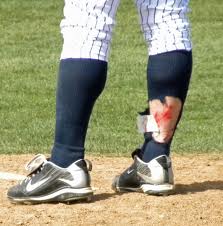
Injury Risk Number One - Cleating yourself -  and perhaps one of the most annoying things that I remember from wearing metal baseball cleats when I was young - cleating yourself. I remember the pain of the metal cleat hitting my own ankle. This is more of an annoyance than anything.


Injury Risk Number Two - Getting Cleated by your opponent - One of the most common "metal cleat injuries" occurs when a base runner slides into a base and spikes the fielder. As the runner slides the cleats are exposed toward the fielder's glove, leg or foot. Of course a runner sliding head first can get his hand stepped on by a fielder with metal cleats.


Injury Risk Number Three - Too much traction - Players prefer metal cleats because they provide superior traction, however too much traction at the wrong time can result in a serious knee or ankle injury. In the game of baseball quick changes of direction happen all the time. 


(Example One) Aggressive players always look to turn a single into a double by hustling down to first and taking an aggressive turn after a hit to the outfield. If the outfielder bobbles the ball they are ready to take advantage, but if the player fields the ball clean and comes up throwing, the runner quickly reverses direction. If the runner's metal cleats dig in deep as the player is turning, a player can damage knee or ankle ligaments. This is exactly how I blow out my ACL playing men's fast-pitch softball. And I was wearing plastic molded cleats. 


(Example Two) I have also seen catchers hurt their knees blocking the plate. As the catcher gets the ball, he is suppose to position his left foot on the baseline facing third base, but many put their left foot perpendicular to the line to block more of the plate. A foot anchored in metal cleats at  an improper angle could increase the likelihood of knee and ankle injuries during a play at the plate. (See Baseball-Catcher.com for proper positioning advice)

The Main Point


Is the extra traction worth it? I am not sure that it is for 13 year old baseball players. What do you think? 

We are thinking about getting my son the New Balance baseball cleats which come in wide sizes and are suppose to be one of the most comfortable baseball cleats on the market. 

Feb 20th update:
My son ended up buying the Nike Swingman metal baseball cleats. He also bought the Ignite II Under Armour baseball turf shoes.


Friday, June 25, 2010

Youth Baseball: Catching Every Pitch Counts with Runners On

Catching is a demanding position. At this point in the season with 50 games in the books catchers are sore, bruised and tired.

Game 87

I noticed the other day that my son was starting to feel the effects of catching so many innings. I noticed that he was taking pitches off.

When a runner is on base. The catcher needs to be in position 2, the ready position. The catcher's butt is slightly up, weight on balls of feet and the throwing hand is behind the mitt for a quick transfer.


The other day, it was hot and I could tell my son was tired. When a runner would get on base, he would assume the proper position as seen above. But I noticed that when a runner did not run early in the count my son would assume the kid was not running at all and he would revert to the more comfortable position 1, the relaxed position (below).


As soon as he did this, the runners would take off and steal the base. A sign of a well coached team.

I talked to my son about this after the game. I asked him if he was tired. He said that he was. I said regardless, you cannot take any pitches off when there were runners on. Your team is counting on you. He said that he did not realize he was doing that.

"Well" I said, "this is a good learning experience. Take this knowledge an improve as a catcher and use this knowledge to become a better base runner too. Watch the catcher. Take advantage of the tired or lazy ones. You will find that they give you lots of information about the pitch location and speed and if they are poised to throw quickly or not.

The Main Point

Catchers cannot take any pitches off.

Sunday, May 30, 2010

Youth Baseball: Pain and Suffering of Catching

The baseball season grinds on and an injury to my son reminds me of my youth.

Game 59

I watched the game from the stands with the mother of a son who was seriously injured by a line drive last year. While my son is working hard to overcome a prolonged slump, her son is working hard to walk normally again.

In the first inning, my son threw out another base stealer, his 10th of the year. He looked at me with pride in his eyes. In the second inning, a foul ball hit the bottom of his All Star Catching mask. I guess the mask was not fully secure because the mask turned upon impact and the ball got hit my son in the throat. My son fell to the ground immediately and was struggling to breathe. The coaching staff ran onto the field to tend to my son. The mother of the injured player yelled for me to call 911, she  knows that time is critical with serious injuries. I took out my iphone ready to dial.

I asked the coach if I needed to make the call. He held up his hand telling me to wait. I had a flash back to my high school lacrosse days.

I cut toward the goal, the center middie threw me a perfect pass. I caught the ball and was immediately decked with a cross check to my throat. My feet continued forward as my head hit the ground. I remember staring up at the clouds while grasping for air as panic set in. 

My son started to calm down and breathe normally. His neck hurt for a few days, but it turns out that like my situation, the panic was worse than the pain.

The Main Point

Committed dads feel all the frustrations, the joy and the pain that their kids experience in sports. Try to limit the pain by making sure that your kids sports equipment fits properly and is in good working condition.

Thursday, April 8, 2010

Developing Young Baseball Catchers

The catching position is the most demanding position in baseball. It is both mentally and physically challenging. It's also one of the most important positions in baseball. A good catcher can shut down a running game. A good catcher can make pitchers better. Yet coaches rarely teach the proper mechanics of catching. Quite frankly, most little league coaches don't have a clue on how to coach the position.

My son works with a hitting coach, Coach K, twice a month during the winter. Coach K, a former catcher in the Expos farm system, is a very successful high school coach. Throughout Coach K's tenure as HS coach, all of his starting catchers have earned all-city honors. So I can say with confidence that Coach K knows how to coach the proper mechanics for receiving, framing, blocking, throwing and fielding the catching position.

When my son made his select team he found himself in the outfield. On his previous team he typically played SS or 3B. He wanted desparatly to be closer to the action. He asked for my advice. I told my son that he needed to pick the position that he wanted to play and work harder than anyone else on the team. He thought about for a few days. He surprised me when he said that he wanted to be a catcher. You cannot get any closer to the action than catcher.

His team had two outstanding catchers who played 90% of the innings and one backup who played 10%. One of the primary catchers was the coach's son. My son worked with Coach K every other week all winter in hopes of winning at least the backup role. I tried to prepared him that he may work hard all winter and still not get a shot. My son was a quick study and learned the proper mechanics that winter. My son was given a chance in the preseason to prove himself. When the season started, my son was the backup catcher. By the end of the season, he earned the primary catcher position and became the captain of the team.

We were lucky to have a Coach K. If you do not have access to a Coach K type a great source of information on the proper mechanics of catching can be found on a website dedicated to the position called Baseball-Catcher

Tuesday, March 23, 2010

Pop Up to the Catcher

Game 7

The third game of the Tennessee tournament was a match up of the 4th and 5th seeds from pool play. My son's team qualified 4th by beating the 5th seed head to head the night before. Well the team did not do as well the second time around. The 5th seed team pitched their ace against some of our new kids. My son was the catcher for the 2nd, 4th and 6th innings and batted 2 times. In his final AB he walked and was eventually thrown out at the plate to end the game in the 13-2 loss. He was being overly aggressive in the lopsided game. The coach did not yell at him, but he knew he made a mistake and was mad at himself. 

After the game we walked back to the car, I know not to talk to him in a situation like this. We walked in silence and packed up the car. I broke the silence by asking if he wanted to go to Cici's pizza before the long drive home. He loves the cinnamon buns there. He said yes. I broke the ice about the game by saying what a great play he made on a pop up that was straight above his head. While it looks easy to the casual fan, a pop up straight above the plate is hard to pick up with a catchers mask on. My son handled it like a seasoned pro. My son said, "yeah that was pretty good, I would have had the other pop up down the 3rd base line if the 3rd baseman did not call me off." That ball dropped to the ground. Remembering that play seemed to cheer him up.  The Stats Dad also told him that the other team only scored 1 run in the innings that he was catching. I also reminded him that no one out hustled him when he was on the field. He felt pretty good about those things.

We had a good time riding home and listening to NCAA basketball on the XM Radio.

Followers

LinkWithin

Related Posts with Thumbnails