
My daughter, CC, is in a fight for a starting position for the first time in her soccer career. She has been a standout soccer player since she was 6 years old. Recently, she was selected to the Ohio State Pool ODP team as a goalie after making it through 3 tryout phases. That does not seem to matter as the club season comes to an end.
During her 12 years, she has made every team she has ever tried out for and she always seems to be selected to play key positions. Outside of sports, she has been a star too. Life has been very easy for my little girl.
Has life been too easy? Would CC fold under pressure and quit or fight to overcome adversity when she needs to. I really had no idea, but I am in the process of finding out.
CC has been the starting goalie of her select team for 2 full years now. CC is very small compared to other players who have already matured. She is the smallest goalie in the top regional league in which she competes. The ODP trainers were not concerned about her size when they selected her for the state pool team, but I know that the coach of our team would like CC to play bigger. I read that as code for she would prefer a bigger goalie.
4 weeks ago, CC injured her shoulder in a game. CC thought it was a bruise. She complained about it hurting all week, but continued to practice and play. The pain did not subside, so we decided make an appointment to see an orthopedic doctor. CC did not want to go because she thought that they would shut her down for the last three weeks of the season. We did not want to risk a serious injury so we insisted.
CC was diagnosed with a slight shoulder separation and severe tendonitis. Surprisingly, the doctor told CC that she could continue to play out the remainder of the season if she could take the pain. He said there is no structural damage so the condition will not get any worse. He then told her that it won't get any better either until she rests it for 3 weeks and completes some physical therapy.
The following weekend, CC decided to rest for 2 games so that she could be ready for an important big game against the best team in the city the following Monday. Nothing was going to keep her out of that game, except rain which postponed the contest.
The coach called up the B team goalie, who is a big strong and athletic girl. The new goalie played well in the two games CC rested. After those games, the coach asked the B team goalie to join the team for the rest of the season. The coach wanted a backup just in case CC's shoulder acted up and she admitted to me that she wanted to test the new option out for next year and perhaps carry two goalies. CC was in a battle.
The Main Point
I talked to CC about the situation. I told her that it was actually a good situation. After I said that, she looked at me with a confused look. I told her that life has been too easy so far and it unrealistic to think that you will go through life without challenges. I told her that she had two choices, quit or fight for your position. I know that she has been considering concentrating on Volleyball, so I did not know what she would do. I was not going to force her to play if she did not have the heart for it. She sat in silence for a few minutes and then I asked her what she wanted to do. She said she is not giving up. We talked about what she needed to do to earn the respect of the coach again.
CC started an important game last Sunday. She played very well in the first half and made several key saves. She got some ice for her shoulder and prepared to sit on the bench for the last half, however, the coach sent CC out to start the second half. CC made this key save late in a 0-0 game on Sunday. The coach was pleased with CC. She came up big, she played big.
Kids learn more through adversity then they do through triumph.
Showing posts with label Sports Injuries. Show all posts
Showing posts with label Sports Injuries. Show all posts
Tuesday, May 21, 2013


Sunday, November 11, 2012
I swear I didn't make my daughter play injured.
I do not miss many games at all. I am lucky to have a job that I can manage my own schedule fairly easily.
I do not miss my kid's games because I do not want to miss the action. I want to be there when my daughter sinks a three at the buzzer or when my son makes a birdie on 18 to win a tournament. I want to see their faces when it happens. I want them to see my proud reactions too. I also want to be there just in case something happens. If they get injured, I want to be there to help comfort them. We all know that injuries are a part of youth sports. It is just a question of when, where and how bad.
I missed a game on Sunday.
I dropped CC off at soccer tryouts for the Ohio South Olympic Development Program. I normally stay to watch, but I had to leave to get to the Cincinnati Bengals / NY Giants game.
I'm a huge Giants fan, so my wife bought me the NFL tickets for my birthday. What she did not know when she made the purchase in September was that my daughter would be competing in the finals of the 6th grade CYO Girl's Basketball Cincinnati Division I Championship. When I realized the conflict, I did not want go to the football game. I would much rather watch my daughter play. I contemplated not going to the NFL game, but the tickets were very expensive. I could have sold the tickets on StubHub, but it was going to be my wife's and son's first NFL game. They were very excited to go. I was torn, but had to go to the Giants game.
During soccer tryouts, CC got hurt in a freak accident. She was on the sidelines next to the goal awaiting her chance to get into the game. The coaching staff was rotating three goalies in each goal. CC was stretching and talking to the other goalie while the other girls on the field were showcasing their skills for the evaluators. CC was not really paying attention to the game.
A striker in the game took aim at the goal and fired a really hard shot. The ball missed the goal and hit the very top of CC's foot. She was relaxed and not expecting the impact, so her ankle snapped back. It hurt a lot, but CC did not want anyone to know. ODP Goalies need to be tough.
She hopped up to walk it off and get the ball that ended up 20 yards behind her. She was trying desperately not limp. Just as she retrieved the ball, the tryout ended. Luckily, she did have to get back in the goal with a bum ankle.
After the training session was complete, she found her club teammates and her ride home. She arrived home to an empty house. She iced her ankle which was now really swollen. She then found an ankle brace, tied it on tight and awaited her ride to basketball. She was not going to miss the Championship basketball game.
A basketball teammate picked her up and took her to the game. She participated in warm ups trying not to limp. She did not want the coaches to bench her. She ended up playing the entire first quarter and the first half of the second quarter before she got a break. During her down time at he end of the second quarter and half time, the ankle swelled more. She tried to play in the third quarter, but could not play at her normal frenzied pace. She sat out the rest of the game unable to take another step.
CC's team went on to win the Cincinnati City Championship and ended the season undefeated with a 26-0 record.


We arrived after the game. As soon as she saw us, she started to cry. We knew she was hurt because we got a text telling us that she sprained her ankle. We were not expecting it to be too bad. We took her sock and shoe off. It did not look very good at all.
This morning, she could not walk. We took her for an X-ray. The X-ray was negative. The doctor was concerned about the ligaments on the top of her foot, so he gave her a boot to wear for a week. We will go for a follow-up next week.
The Main Point
Some parents push their kids to play even when they are hurting. Some kids push themselves.
Tuesday, September 11, 2012
Youth Baseball: Pitchers Should Wear Helmets
Oakland A's pitcher Brandon McCarthy was hit in the head by a line drive. The blow to the head instantly dropped him to the ground. He was able to get up and walk off the field, but he suffered a epidural hemorrhage, a brain contusion and a fracture skull that required a two hour surgery.
Brandon McCarthy was lucky, he was released from the hospital today.
There have been kids that were not so lucky. Seemingly, every year kids die. I have written about this subject several times in the past.
Here is the deal. It is quite simple. The powers that control little league baseball have already mandated BBCOR bats to protect pitchers. Now they need to mandate helmets for pitchers.
All pitchers should wear helmets. I wish MLB would mandate it. The MLB makes first base coaches wear helmets, so it can be done. MLB should decree it to protect big league players. More importantly, the MLB should decree it to set an example for little league, HS, College and minor league players.
At the very least, I would love to see a prominent MLB pitcher wear a helmet to show kids that it is not uncool.
The Main Point
Parents do not need to wait until the MLB mandates the use of helmets. They should talk to their kid's coach and make it a requirement for pitching. My son didn't pitch much, but when he did, he wore a helmet. When my son was younger, his coach made everyone wear them. His coach did this because one of his players almost died from a line drive to the head. Almost 5 years later, that player still struggles with the debilitating affects of the injury. My son knows the kid very well, so it does not take any effort to get my son to wear a helmet when he is pitching.
Buy a helmet from the link below.


Wednesday, June 27, 2012
Youth Sports Injuries: Consider the Big Picture
When your kid gets an injury that sidelines him or her, do you look at the big picture?
Do you talk toughness - playing through pain like Ripken and Gehrig?
Or do you take a more cautious approach?
When your kid is sidelined, does he or she understand the big picture?

On June 18th, my son hit the waiting room at the orthopedic doctor and was diagnosed with a hip flexor strain. The combination of baseball and golf and growing led to the problem.
He has been on the disabled list since. He missed 4 games last weekend when the team played in a big local tournament. He missed a game played at Marge Schott Stadium on the University of Cincinnati. And it looks like he will miss a big tournament in Columbus this weekend.
He has been going to physical therapy, taking his anti-inflammatory drugs, heating, icing and stretching as prescribed. The doctor said that he would be out 1 to 2 weeks.
He is almost ready to come back, but we are being cautious for three reasons. We do not want him to come back early and re-injure the hip and
1) miss out on the Nations Baseball World Series in Florida.
2) jeopardized tryouts for the high school golf team.
3) jeopardized tryouts the 2013 club baseball season. (There is a chance our team is going to breakup.)
At dinner the other night, we asked him what the physical therapist said about the timetable to get back on the field. He said with a big smile, "Another week, but I am going to give it a try tomorrow night." We said, "Really."
Still smiling, he said, "You guys are not looking at the short picture here. You are constantly looking at the big picture."
The Main Point
My son misses baseball and golf but he sees the big picture. If he returns too early and tears the hip flexor from the bone, he will be out a long, long time. He does not want to risk the Florida trip or the tryouts.
I am not as patient. I cannot wait for him to start playing again.
Tuesday, June 19, 2012
Youth Sports: Female Athletes and Concussions
My daughter, CC, is small compared to the girls that she competes against in basketball. The elbows of these much larger girls are at the eye level of CC. Regardless, she does not back down. This gives me a great sense of pride, but it also makes me a bit nervous.


If you are proud for your tough daughter, yet a bit concerned about head injuries like I am, then follow the link and watch Concussion and the Female Athlete: The Untold Story. The video was created by the University of Minnesota Tucker Centre for Research on Girls and Women in Sport.
The Main Point
Learn about concussions and make informed decisions if your daughter, or son for that matter, gets a concussion. The window of opportunity for sports is small, so parents and athletes often make irrational decisions regarding injuries. There are lots and lots of games and lot of life to live after the games are over. Take the time necessary to heal.
Sunday, December 4, 2011
Youth Baseball: Another Injury Scare
Last week, my son's baseball career flashed before his eyes after an awkward swing during an indoor winter practice had him clutching his elbow. The elbow swelled immediately and turned purple.
 |
| 6 yrs old |
 |
| 7 yrs old |
 |
| 8 yrs old |
 |
| 9 yrs old |
 |
| 10 yrs old |
 |
| 11 yrs old |
 |
| 12 yrs old |
 |
| 13 yrs old |
As we drove home from practice, my son iced his arm. I could see the worry in his eyes as he stared straight ahead without saying much. I felt so sorry for him.
Baseball is his love. In fact, he recently started some grueling work outs with a personal trainer to increase arm strength. He also started working with a baseball trainer to improve his throwing mechanics. Ironically, he was doing all of this to avoid arm injuries.
He has had arm injuries before. At age 10, he broke the growth plate in his elbow while he was pitching. That healed fairly quickly, but while the elbow was healing, his shoulder became weak. The shoulder weakness led to shoulder pain. He battled arm discomfort off and on. Last year, he was injury free and he was really looking forward to a breakout year in 2012.
We had to wait to call for an appointment with an orthopedic because his latest injury happened on a Sunday. The ice and Advil seemed to eliminate the swelling and discoloration. The pain was minimal. Still, we made an appointment to see the doctor.
The doctor suggested an MRI and it took a week to schedule the MRI. During that long week, my son wondered if he would be playing baseball in the spring or recovering from surgery.
Fortunately, the MRI came back negative. There was no bone or ligament damage. The swelling and discoloration was the result of a minor bursae sac issue. I was thrilled for my son and, quite frankly and selfishly, for myself. I love to watch him play and get a sense of pride from his accomplishments.
My son's baseball career was back on track and he was back in the gym the day after the results came back.
The Main Point
All dads know how unlikely it is that their son will make the pros or even play in college. To make it, a player needs to be a very special talent, be seen by the right people at the right time and stay healthy.
Every time I think about how unlikely it is that my son will advance in baseball, I also consider that every college and pro ballplayer has a dad who wondered the same thing. So there is a chance. The results of the MRI kept those slim chances alive.
Wednesday, November 30, 2011
Youth Soccer: Is Heading A Soccer Ball Safe?
A new study suggests that heading a soccer ball might not be safe after all.
A friend of my was playing goalie in a friendly pick up game. The field was filled with both US and foreign born ex-college players ages 25 to 45. During a game one Sunday, a powerful midfielder ripped a shot. My friend went to save the ball and the bone in his arm snapped through his skin proving that a soccer ball can cause damage.
So why doesn't a headed soccer ball cause brain injuries?
 I know that ball contracts on impact to mitigate the force, but still, a professional soccer player can kick a soccer ball up to 80 mph.
How can that not cause brian damage?
This is a question that I have thought about often, but not enough to look for an answer because I considered that soccer has been played for years and years all over the world and brain injuries from a headed ball have never been a major concern. I would consider the world-wide history of soccer a big long conclusive test. If there were a problem with heading, then FIFA, SAY and any other organizing soccer body would have outlawed heading. So I just blindly assumed that heading a soccer ball was safe even if it did not make intuitive sense. Of course, the game is not without head injures, but soccer head injuries seemed to be confined to heads hitting heads, heads hitting goal posts and heads hitting the grounds.
Well, a new study suggests that heading a soccer ball may cause brain function issues. The study was presented at the Radiological Society of North America today. The study suggests that repeated heading is the issue, not the force of a single impact. Again, it makes intuitive sense to me, but then again, I look back on the long history of soccer wonder why issues have not surfaced prior to this study. I guess a lot of research needs to be done before there will be conclusive report.
The Main Point
So I conclude that if you put modern medical equipment to the test you can detect changes in the brain from repeated heading. If you put history to the test you can conclude that the changes detected from the modern equipment must not be consequential.
Heading is a vitally important part of the game on both the offensive and defensive side of the ball. The best advice I can give a soccer mom or dad is to make sure that your kid's coach is teaching the proper technique at age 10 and up.
I do not think that players under 10 years old need to be heading a soccer ball. I say this not because it is conclusively proven to be dangerous to developing brains, but because players of this age do not know the proper technique. This can cause injuries. Kids this age often close their eyes and let the ball hit them on the top of the head (not the forehead where the most protective bones are). This does not feel very good and fear develops. This fear from poor initial technique will undermine the confidence needed to properly execute a header when they get older. Besides, young players 10 and under have so many things to master first.
Click here for the proper technique for heading a soccer ball
My son was a terrific player in the air. In soccer terms that means he was a very good at heading a ball. He attacked the ball.


A friend of my was playing goalie in a friendly pick up game. The field was filled with both US and foreign born ex-college players ages 25 to 45. During a game one Sunday, a powerful midfielder ripped a shot. My friend went to save the ball and the bone in his arm snapped through his skin proving that a soccer ball can cause damage.
So why doesn't a headed soccer ball cause brain injuries?

How can that not cause brian damage?
This is a question that I have thought about often, but not enough to look for an answer because I considered that soccer has been played for years and years all over the world and brain injuries from a headed ball have never been a major concern. I would consider the world-wide history of soccer a big long conclusive test. If there were a problem with heading, then FIFA, SAY and any other organizing soccer body would have outlawed heading. So I just blindly assumed that heading a soccer ball was safe even if it did not make intuitive sense. Of course, the game is not without head injures, but soccer head injuries seemed to be confined to heads hitting heads, heads hitting goal posts and heads hitting the grounds.
Well, a new study suggests that heading a soccer ball may cause brain function issues. The study was presented at the Radiological Society of North America today. The study suggests that repeated heading is the issue, not the force of a single impact. Again, it makes intuitive sense to me, but then again, I look back on the long history of soccer wonder why issues have not surfaced prior to this study. I guess a lot of research needs to be done before there will be conclusive report.
The Main Point
So I conclude that if you put modern medical equipment to the test you can detect changes in the brain from repeated heading. If you put history to the test you can conclude that the changes detected from the modern equipment must not be consequential.
Heading is a vitally important part of the game on both the offensive and defensive side of the ball. The best advice I can give a soccer mom or dad is to make sure that your kid's coach is teaching the proper technique at age 10 and up.
I do not think that players under 10 years old need to be heading a soccer ball. I say this not because it is conclusively proven to be dangerous to developing brains, but because players of this age do not know the proper technique. This can cause injuries. Kids this age often close their eyes and let the ball hit them on the top of the head (not the forehead where the most protective bones are). This does not feel very good and fear develops. This fear from poor initial technique will undermine the confidence needed to properly execute a header when they get older. Besides, young players 10 and under have so many things to master first.
Click here for the proper technique for heading a soccer ball
My son was a terrific player in the air. In soccer terms that means he was a very good at heading a ball. He attacked the ball.


Wednesday, September 28, 2011
Youth Baseball: BBCOR Bats for Christmas?
My son wants a new BBCOR bat for this fall ball season and for next spring. I told him we are going to wait until our league officially announces the BBCOR bat mandate.
My other reason is that it saves me money to give it to him as a Christmas present instead of a random purchase. (Dad secret.)
Before you buy - read this post and check out the BBCOR comparison app by baseball express.
Before you buy - read this post and check out the BBCOR comparison app by baseball express.

2012 BATS:
At the league meeting on Saturday, we’ll be discussing the BBCOR bat issue. I am not 100% certain at this point what the league is going to do, but wanted to give you a heads up on the issue.
The new BBCOR standard measures bat performance and replaces the previous BESR (Ball Exit Speed Ratio) standard. The NCAA required BBCOR baseball bats for the 2011 season. For NFHS (National Federation of High Schools), all bats must be BBCOR certified for the 2012 season. I expect the league to follow the NFHS for 13U and up at a minimum.
BBCOR stands for Batted Ball Coefficient of Restitution (What?). Simply put, it’s a measurement of the LOSS of energy for both the ball and the bat at impact. Instead of measuring the speed of the ball after it is batted (BESR and the current standard), BBCOR measures the “trampoline” effect on BOTH the ball and the bat. A PITCHED ball holds a lot of energy, with wood bats much of that energy is lost as the ball compresses on impact with a dense surface. With hollow-core aluminum or composite bats (most of our current bats) the thin walls flex which distorts the ball less therefore the ball retains more of its original PITCHED energy plus gains the power of the bat’s speed and the bat’s flexibility. The less energy lost from the pitched ball, the faster the BATTED will be launched off the bat - therefore non-wood bats hit balls FASTER than wood bats.
For more details see http://www.stevetheump.com/BBCOR.htm
and/or http://baseballexpress.wordpress.com/ncaa-bat-ban/
and/or http://baseballexpress.wordpress.com/ncaa-bat-ban/
Why not just go to wood? Money. The expense would increase annual operating costs significantly – especially for a 24+ man high school or 35 man NCAA rosters.
The bottom line – new bats under the Christmas tree will have to carry the BBCOR stamp on the bat and may be inspected by umps this year.
LOWER YOUR EXPECTATIONS
The bat you put under the tree will have less hits in it
From the NCAA:
Division I batting average, scoring and home runs per game in 2011 resemble the wood-bat 1970 era.
Division I teams in 2011 averaged 5.58 runs per game, well off the record 7.12 in 1998.
Home runs left parks at an average of .52 per team per game in 2011 compared with .94 last year and 1.06 in 1998 (also the peak year for that category). That resembles wood-bat days, too (.42)
Batting average in 2011 was .282, the lowest since 1976.
Note - earned-run average, on the other hand, was its best (4.70) since 1980 (4.59).
The Main Point
Friday, August 12, 2011
Youth Baseball: Curve Balls Not Taboo Anymore?
 |
Study shows: The force of a fastball on an
elbow is equal to or greater than a curve.
|
I faced my first curveball when I was 11 years old. Very few 11 year old kids threw the taboo curveball, so I still remember the pitcher's name, Ricky Franco. His curveball was nasty. Well it was nasty for kids who had never see one up close before. He was not overpowering, but he made me look foolish with knee buckling curves on more than one occasion. I remember our coach saying that that kid's arm will never last. I was thinking I will never last if I cannot hit a curveball. I'm not sure how long Ricky pitched.
A recent 5 year study conducted by North Carolina and backed up by another 10 year study The American Sports Medicine Institute which was founded by the famous Dr. James Andrews, indicates that overuse and not curve balls is the problem. Read the USA Today article STUDY: Overuse, not curveballs leads to injuries.
The Main Point
Let's face it, anyway you throw a baseball is a physically abusive and unnatural motion. Proper mechanics and proper rest are imperative for young pitchers, no matter what pitches they have in their repertoire.
Still I am glad my son did not throw a curve while he was younger.
Are you going to let your son throw curves now?
Still I am glad my son did not throw a curve while he was younger.
Are you going to let your son throw curves now?
Sunday, May 8, 2011
Youth Baseball: Metal or Molded Plastic Cleats What to do? (Part 2)
On January 3rd, I wrote a post questioning metal cleats for 13 year old baseball players. I enumerated the risks involved.

Nic was playing catcher in the game so the coach used a courtesy runner to allow Nic to go to the dugout without officially leaving the game. In the dugout, the team mom cleaned up the wounds and determined that the cuts would not need stitches. His hand was swollen and he had trouble closing his hand at first, but he had time to ice it before his next at bat. I was making plans in my mind to go to the urgent care to get the hand x-rayed, while his coach was trying to figure out how to adjust his defensive game plan. Nic's turn to bat came up and he was determined to give it a go. Nic hit a double over the right fielders head. We all figured he was going to be ok. He also played the second game of the doubleheader and had 2 more hit.
 At night, we watched Celtics Rajon Rando dislocate his elbow, go into the locker room for treatment and then return to lead the Celtic's in a win over the Lebron James, Dwayne Wade Heat.
 The Main Point
Injury Risk Number Two - Getting Cleated by your opponent - One of the most common "metal cleat injuries" occurs when a base runner slides into a base and spikes the fielder. As the runner slides the cleats are exposed toward the fielder's glove, leg or foot. Of course a runner sliding head first can get his hand stepped on by a fielder with metal cleats.During the first game of the doubleheader on Saturday, my son Nic was diving back into first base when the first baseman stepped on his hand. The metal cleat lacerated the webbing between his pinkie and ring finger and cut the fleshy part of the side of the hand above the pinkie.
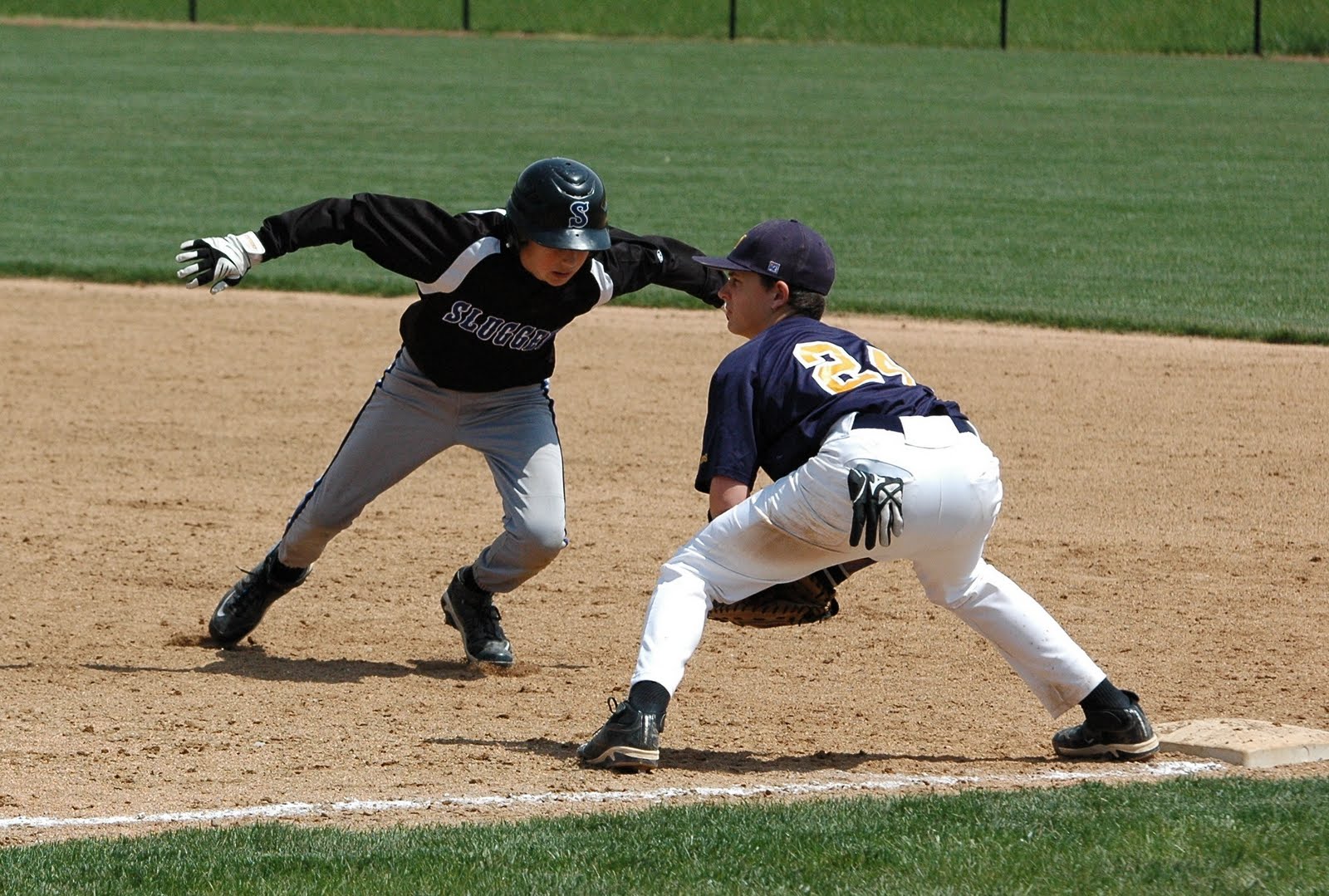
Nic was playing catcher in the game so the coach used a courtesy runner to allow Nic to go to the dugout without officially leaving the game. In the dugout, the team mom cleaned up the wounds and determined that the cuts would not need stitches. His hand was swollen and he had trouble closing his hand at first, but he had time to ice it before his next at bat. I was making plans in my mind to go to the urgent care to get the hand x-rayed, while his coach was trying to figure out how to adjust his defensive game plan. Nic's turn to bat came up and he was determined to give it a go. Nic hit a double over the right fielders head. We all figured he was going to be ok. He also played the second game of the doubleheader and had 2 more hit.
 At night, we watched Celtics Rajon Rando dislocate his elbow, go into the locker room for treatment and then return to lead the Celtic's in a win over the Lebron James, Dwayne Wade Heat.

I still question whether the extra traction worth it. My son thinks that it is worth it for the cool factor alone. He loves his Nike Swingman cleats.
And he got a big smile on his face when I compared his situation to the Rondo injury and return.
And he got a big smile on his face when I compared his situation to the Rondo injury and return.
Tuesday, May 3, 2011
Youth Baseball: A Return to the Mound After an Injury
My son, Nic, has had arm problems off and on during his baseball career. (Read Elbow Injury) Last year was a particularly frustrating year for my son. Toward the end of the season, a doctor shut him down. An MRI revealed no structural damage, but a physical test revealed that his shoulder was very weak and was causing elbow issues. After a long rest period and physical therapy with trainers, my son started going to the gym and lifting with me. He was able to play fall ball, but limited the amount of throwing he did. During winter training, he work with a baseball coach to rework his throwing motion to correct some bad habits that could be contributing to the injuries.
Nic has continued to work hard with the coach and in the gym. His arms are stronger than they have ever been and his mechanics are sound. He is throwing essentially pain free this season and returned to the mound for the first time in over a year on Sunday.
The Main Point
Don't let arm injuries derail your son or daughter's career. Be smart. When pain persists get a doctors opinion. If the doctor recommends rest and / or therapy, follow the advice. After the doctor supervised therapy, continue strengthening the arm on your own. And don't forget the most important avoiding injury by using the proper mechanics. Get a coach to evaluate your son / daughter's throwing motion. and have them correct any mechanical issues that may be putting the young arm at risk.
Nic has continued to work hard with the coach and in the gym. His arms are stronger than they have ever been and his mechanics are sound. He is throwing essentially pain free this season and returned to the mound for the first time in over a year on Sunday.
 |
| Getting the ball on the bump again |
 |
| First pitch |
|
| First Pitch |
 | |
|
|
| Come backer 1-3 to end the scoreless first inning on the mound |
Don't let arm injuries derail your son or daughter's career. Be smart. When pain persists get a doctors opinion. If the doctor recommends rest and / or therapy, follow the advice. After the doctor supervised therapy, continue strengthening the arm on your own. And don't forget the most important avoiding injury by using the proper mechanics. Get a coach to evaluate your son / daughter's throwing motion. and have them correct any mechanical issues that may be putting the young arm at risk.
Tuesday, March 15, 2011
Youth Sports: Mouth Guards Are Recommended
My daughter is average height for a 4th grader, but considered short when she is on the basketball court playing with amazingly tall 4th grader AAU ballers. Her face is often at the height of swinging elbows which puts her at risk of bloody lips and lost teeth.

The Main Point
I need to get my daughter to wear a mouth guard. She has had 2 bloody lips since the AAU season started 3 months ago. Luckily she has not lost any teeth. She has also taken a charge and fell back and hit her head. Read Youth Basketball: Busted Lip
According to the post on www.GirlsplaySports.com mouth guards are proven to reduce the risk of concussions too.
I have seen some kids wear mouth guards for basketball and soccer. I would guess about 2 out of 10 at the most. If my daughter started wearing one, she be the only one on her current basketball team wearing one. No one on her soccer team wears one this year either, although two girls did last year.
She is proud and will resist wearing a mouth piece until someone else wears one. She will need to convince her best friend to do it with her.

There is a great post on www.girlsplaysports.com called Mouth Guards are a Must... It is a must read of parents of all athletes boys and girls.
The Main Point
I need to get my daughter to wear a mouth guard. She has had 2 bloody lips since the AAU season started 3 months ago. Luckily she has not lost any teeth. She has also taken a charge and fell back and hit her head. Read Youth Basketball: Busted Lip
According to the post on www.GirlsplaySports.com mouth guards are proven to reduce the risk of concussions too.
I have seen some kids wear mouth guards for basketball and soccer. I would guess about 2 out of 10 at the most. If my daughter started wearing one, she be the only one on her current basketball team wearing one. No one on her soccer team wears one this year either, although two girls did last year.
She is proud and will resist wearing a mouth piece until someone else wears one. She will need to convince her best friend to do it with her.
Wednesday, February 16, 2011
Youth Basketball: Busted Lip
In an earlier post called Youth Baseball: Hit in the Face with a Pitch, I wrote about the unwritten youth sports rule that parents should not run onto the field when their kids get hurt. When my son got hit in the face with a fastball, I resisted the urge to run on the field.
The other day, my daughter jumped in front of an opponent who was driving to the hoop. She got her feet set and took the charge. The bigger girl hit her hard and my daughter fell back and hit her head. I watched and worried from the stands. (She turned out to be OK - no concussion)

The very next game, I'm embarrassed to say that I broke my rule.
My daughter's 4th grade team was playing a much bigger 5th grade team. In the first quarter, my daughter was working the ball up the court trying to break a press. As she crossed the half court line very close to the scoring table where I was sitting, she collided heads with a defender. She immediately looked at me with fear and tear filled eyes. She was holding her mouth. She removed her hands to look at her hands. Her face and hands were full of blood. She looked back at me. Her eyes were telling me, "Daddy why aren't you helping me. I need help." I ran onto the court. I could not resist. My wife did not run onto the court.
Luckily CC only busted her lip and did not lose any teeth. My tough little girl, eventually went back into the game.
The Main Point
I am not sure why I ran on to the court when my daughter, CC, was hurt but did not run on to the baseball field when my son was hit in the face with a pitch. Perhaps because CC is my baby, perhaps because she is a girl. Girls are as tough as boys, I should have stayed on the sidelines.
Sunday, January 30, 2011
Youth Baseball: Metal or Molded Plastic Cleats What to do?
My son is starting his U13 baseball this year. U13 is the first year that the AABC league allows metal cleats. I know that metal cleats offer much better traction on both hard and soft dirt fields and on the grass outfields and infields, but is it worth the potential risks?
My son wants to get metal cleats and I suppose that I will allow him to do so. I have expressed my concerns and I have shared with him the risks. Like most decisions, I will allow him to make his own educated decisions.
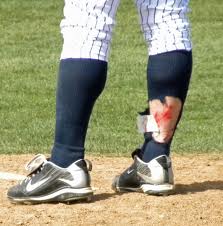 Injury Risk Number One - Cleating yourself - and perhaps one of the most annoying things that I remember from wearing metal baseball cleats when I was young - cleating yourself. I remember the pain of the metal cleat hitting my own ankle. This is more of an annoyance than anything.
Injury Risk Number Two - Getting Cleated by your opponent - One of the most common "metal cleat injuries" occurs when a base runner slides into a base and spikes the fielder. As the runner slides the cleats are exposed toward the fielder's glove, leg or foot. Of course a runner sliding head first can get his hand stepped on by a fielder with metal cleats.
Injury Risk Number Three - Too much traction - Players prefer metal cleats because they provide superior traction, however too much traction at the wrong time can result in a serious knee or ankle injury. In the game of baseball quick changes of direction happen all the time.
(Example One) Aggressive players always look to turn a single into a double by hustling down to first and taking an aggressive turn after a hit to the outfield. If the outfielder bobbles the ball they are ready to take advantage, but if the player fields the ball clean and comes up throwing, the runner quickly reverses direction. If the runner's metal cleats dig in deep as the player is turning, a player can damage knee or ankle ligaments. This is exactly how I blow out my ACL playing men's fast-pitch softball. And I was wearing plastic molded cleats.
 (Example Two) I have also seen catchers hurt their knees blocking the plate. As the catcher gets the ball, he is suppose to position his left foot on the baseline facing third base, but many put their left foot perpendicular to the line to block more of the plate. A foot anchored in metal cleats at an improper angle could increase the likelihood of knee and ankle injuries during a play at the plate. (See Baseball-Catcher.com for proper positioning advice)
The Main Point
My son wants to get metal cleats and I suppose that I will allow him to do so. I have expressed my concerns and I have shared with him the risks. Like most decisions, I will allow him to make his own educated decisions.
Injury Risk Number One - Cleating yourself - and perhaps one of the most annoying things that I remember from wearing metal baseball cleats when I was young - cleating yourself. I remember the pain of the metal cleat hitting my own ankle. This is more of an annoyance than anything.Injury Risk Number Two - Getting Cleated by your opponent - One of the most common "metal cleat injuries" occurs when a base runner slides into a base and spikes the fielder. As the runner slides the cleats are exposed toward the fielder's glove, leg or foot. Of course a runner sliding head first can get his hand stepped on by a fielder with metal cleats.
Injury Risk Number Three - Too much traction - Players prefer metal cleats because they provide superior traction, however too much traction at the wrong time can result in a serious knee or ankle injury. In the game of baseball quick changes of direction happen all the time.
(Example One) Aggressive players always look to turn a single into a double by hustling down to first and taking an aggressive turn after a hit to the outfield. If the outfielder bobbles the ball they are ready to take advantage, but if the player fields the ball clean and comes up throwing, the runner quickly reverses direction. If the runner's metal cleats dig in deep as the player is turning, a player can damage knee or ankle ligaments. This is exactly how I blow out my ACL playing men's fast-pitch softball. And I was wearing plastic molded cleats.
(Example Two) I have also seen catchers hurt their knees blocking the plate. As the catcher gets the ball, he is suppose to position his left foot on the baseline facing third base, but many put their left foot perpendicular to the line to block more of the plate. A foot anchored in metal cleats at an improper angle could increase the likelihood of knee and ankle injuries during a play at the plate. (See Baseball-Catcher.com for proper positioning advice)The Main Point
Is the extra traction worth it? I am not sure that it is for 13 year old baseball players. What do you think?
We are thinking about getting my son the New Balance baseball cleats which come in wide sizes and are suppose to be one of the most comfortable baseball cleats on the market.
Feb 20th update:
My son ended up buying the Nike Swingman metal baseball cleats. He also bought the Ignite II Under Armour baseball turf shoes.
Thursday, December 9, 2010
Youth Sports: Raising Awareness of Sports Injuries (Part 3)
 I love sports stats, but there is nothing to like about the stats that are posted on the Sports Safety Alliance Website.
The Sports Safety Alliance believes that there is a rising safety crisis in America. The number of league sports and community opportunities to play athletics is on the rise and so are the injuries. If the posts in this blog about the now 180 games played and countless practices, 1 MRI and 2 X-rays over the last 10 months is not convincing enough check out the sample of the stats from the Sports Safety Alliance site.
The sports safety crisis is evidenced by:
- There were 120 sports-related deaths in 2008-2009, in 33 states.
- Approximately 8,000 children are treated in emergency rooms EACH DAY for sports-related injuries.
- 50% of “second impact syndrome” incidents – brain injury caused from a premature return to activity after suffering initial injury (concussion) – result in death.
- The CDC reports that high school athletes suffer 2 million injuries, 500,000 doctor visits, and 30,000 hospitalizations each year.


- Female high school soccer athletes suffer almost 40% more concussions than males (29,000 annually).
- Female high school basketball players suffer 240% more concussions than males (13,000 annually).
- 400,000 brain injuries (concussions) occurred in high school athletics during the 2008-09 school year.
- 62% of organized sports-related injuries occur during practices.
The Main Point
The main point comes directly from the Sports Safety Alliance website in their CALL to ACTION.
- Ensure that youth athletes have access to health care professionals who are qualified to make assessments and decisions.
- Educate your family about the symptoms of musculoskeletal and neurological injuries (concussion, heat illness, ACL injuries).
- Ensure pre-participation physicals before play begins.
- Ensure sports equipment and field are checked for safety and best conditions.
- Write to your state legislator, expressing your concerns.
- Support further research into youth sports injuries and their effects.
- There’s a difference between pain and injury – work to eliminate the culture of “playing through pain” without assessment.
Subscribe to:
Posts (Atom)
LinkWithin
