Friday, February 18, 2011

Youth Wrestling: Girls Wrestling Boys


This past week, a boy from Iowa named Joel Northrup refused to wrestle a girl in the Iowa state championship tournament. The standout wrestler, ranked 5th in the state with a 35-4 record at the 112 pound division, gave up his dream to become a state champion to adhere to his faith. Read the Daily Tribune article - Iowa Wrestling Standout Refuses to Face a Girl.


I am not really sure where I stand on this debate: 


I am a dad of a girl athlete. Two years ago, my daughter was the only girl in a boys basketball league. She played on the boys team because she was good enough to compete and because there was no organized girls league for her age at the time.  I watched her play with pride. I felt so good when the dads of the other players commented on how good she was. 


I am the husband of a wife who played little league baseball while growing up in Iowa. Like my daughter, she played on the boys team because she was good enough to compete and because the town did not have a girls softball league at the time. She went on to play softball in college.


Cassy Herkelman, the girl Joel Northrup refused to wrestle, earned a spot into the state tournament. She complied a record of 21-13 during the season with eight pins. She finished 2nd at districts. She did that in one of the most, if not the most, competitive states for high school wrestling. Like my daughter and my wife, she competed against boys because she was good enough and because her high school did not have a girls wrestling program. 


Still, I am not sure that girls should be wrestling boys. From reading up on this issue, I understand that some boys feel that wrestling a girl is a no win situation. Apparently, boys who go all out and wrestle a girl to win are often admonished by their peers for beating a girl. On the contrary, boys who hold back or avoid certain holds and end up losing are chastised by their peers. What is a boy to do? But what is a girl to do?


The Main Point


This is a complex issue with two sides of the story. People who only see it one way are myopic.


The one thing that everyone can agree on is that both sides handled this situation with class.


Joel stated:


"I have a tremendous amount of respect for Cassy, however, wrestling is a combat sport and it can get violent at times. As a matter of conscience and my faith I do not believe that it is appropriate for a boy to engage a girl in this manner."


Cassy Herkelman's father stated: 


"My understanding is that they've got strict convictions, and I respect them... I don't have any ill will toward them and I don't think it's any kind of boycott about her being a girl."


The best scenario would be the development of girls wrestling programs in every state. (The following states have girls wrestling California, Hawaii, Tennessee, Texas and Washington.)


Thursday, February 17, 2011

Youth Baseball: Cutting Players

The politics of select baseball drives me crazy.

Crazy Youth Sports Coach Series

Last night, I had a conversation with a frustrated dad regarding U11 select baseball. He is rightfully frustrated with the politics of baseball. Here is his story.
  • His son played on a select baseball team last spring (Team A). 
  • He told me that his son was a not a superstar, but was a good player on Team A.
  • Team A did well in the lowest division of the AABC league. 
  • After the season was over, the coach of Team A told the parents of the players that he was going to move the team up to the next competitive division. The parents approved of the move.
  • The coach also told the parents that he was going to keep the team intact. 
  • As such, Team A did not schedule a tryout.
  • Both my friend and his son were happy with Team A, so they did not participate in tryouts for any other teams during the tryout period last summer (Late July - Early August).
  • During the tryout period last year, another local team (Team B) discovered that several of their kids were unhappy and were going to leave the team.
  • Team B's best 6 kids remained.
  • The coach of Team B and the coach of Team A are friends. They decided to combine their teams.
  • The coach of Team A sent my friend an email telling him that his son was cut. (What a coward)
  • The cut came after the tryout season - so my friend's kid was left without a team and few if any options.
  • The dad called every coach looking for a spot. The frustrating process took weeks.
  • He has a lead on a team, but is concerned that his son will have to go back to recreational ball.
  • He later found out that the remaining six kids from Team A were the sons of the coaches and assistant coaches, not necessarily the best 6 players.

The Main Point

Is this really surprising? College coaches jump teams and leave players in the lurch without suffering any consequences. On the contrary these "role model" college coaches benefit from reneging on their contracts with universities and breaking their promises to players and their families. The NCAA teaches our youth coaches that commitments do not matter.

The coach of Team A is an inconsiderate jerk and a coward. The leadership of the respected club he plays for should have intervened.

Wednesday, February 16, 2011

Youth Basketball: Busted Lip

In an earlier post called Youth Baseball: Hit in the Face with a Pitch, I wrote about the unwritten youth sports rule that parents should not run onto the field when their kids get hurt. When my son got hit in the face with a fastball, I resisted the urge to run on the field.

The other day, my daughter jumped in front of an opponent who was driving to the hoop. She got her feet set and took the charge. The bigger girl hit her hard and my daughter fell back and hit her head. I watched and worried from the stands. (She turned out to be OK - no concussion)


The very next game, I'm embarrassed to say that I broke my rule.

My daughter's 4th grade team was playing a much bigger 5th grade team. In the first quarter, my daughter was working the ball up the court trying to break a press. As she crossed the half court line very close to the scoring table where I was sitting, she collided heads with a defender. She immediately looked at me with fear and tear filled eyes. She was holding her mouth. She removed her hands to look at her hands. Her face and hands were full of blood. She looked back at me. Her eyes were telling me, "Daddy why aren't you helping me. I need help." I ran onto the court. I could not resist. My wife did not run onto the court.

Luckily CC only busted her lip and did not lose any teeth. My tough little girl, eventually went back into the game.

The Main Point

I am not sure why I ran on to the court when my daughter, CC, was hurt but did not run on to the baseball field when my son was hit in the face with a pitch. Perhaps because CC is my baby, perhaps because she is a girl. Girls are as tough as boys, I should have stayed on the sidelines.


Monday, February 14, 2011

Youth Sports Parents: Valentine's Day Advice

Valentine's Day relationship advice for Crazy Youth Sports Parents

Over the past 50 weeks, my two kids have played in 223 games and countless practices. Crazy I know. A schedule like this could put a strain on a marriage, but my wife and I actually think that it brings us together. As parents, we are very involved in our kid's schooling and their non-sports extracurricular activities as well. I guess you can say that we are completely dedicated to our kids.

Well not completely. While we concentrate a lot of time and emotional energy on our kids, we don't forget about each other. We believe that one of the greatest things that we can give our kids (besides time with a personal trainer - i'm kidding) is a happy and healthy marriage. My wife and I both came from broken families and know the toll that divorce takes on kids, so we constantly work at our 15 year marriage. Actually, I am not sure work is the right word because it seems so easy. Of course it helps that we are both compatible sports nuts.

What's our secret for a happy Youth Sports Parents marriage:

  1. Almost every week we have a date night. No kids.
  2. We make joint decisions regarding our kids. (For example, if our kids express an interest in playing a sport or trying out for a particular team,  my wife and I figure out IF and HOW we are going to make it happen together.)
  3. We go to every youth sports event together, if possible. Of course, we often need to divide and conquer when the kids' schedules overlap but for the most part we are in the stands sharing the memories together. When we are apart, we either text each other sports updates or provide play-by-play over the phone.
  4. Finally, every year, my wife and I take a time out from youth sports and go away alone for uninterrupted time together. Yep, once per year, we take off for a warm climate. We leave on a Sunday morning and return on a Friday (5 nights). The last couple of years we have been going to all inclusive resorts. The main benefit to us is five blissful days of not getting into a car to go anywhere. The five day, no kids vacation schedule is ideal on many levels. a) We only miss one weekend day, so we miss very few games. b) The kids are in school most of the hours we are away. This makes it easy on our parents who watch the kids. c) This a perfect amount of time to get away and reconnect - not too short and not too long. d) This is a great time for the grandparents to connect with our kids. All but one grandparent (our kids have 7) live 8+ hours away. e) We have an entire weekend when we return to reconnect with our kids before the work week starts. And to 
We just returned from the Mexican Mayan Riviera. We had a great time. We only missed 2 games and 4 practices.


The Main Point

The over-scheduled youth sports world we live in can make life stressful for kids and parents.  It makes many parents cranky. I can tell you that no one likes to be around cranky people, not even spouses.

My advice, relax and enjoy watching your kids play sports. It will all be done before you know it. And take time away from your kids sports schedules a couple of hours per week and a couple of days per year to connect with your spouse.

Happy Valentines Day youth sports fans. If you do not have a game to watch tonight, take your spouse out. If you do buy something special at the concession stand.


Thursday, February 3, 2011

Youth Sports Interferes with Family Time. I Think Not.

The University of Minnesota conducted research on Youth Sports. The report is called Parents perceptions of how frequently youth sports interferes with family time. 

They conclude that "done right" youth sports can provide a positive and meaningful context for youth development and family engagement. They also express concern that the amped up youth sports world of today can place the health and well being of the children at risk. Overuse injuries, parental pressure to succeed and compromised family leisure time are the main issues.

I agree with the overuse injuries and pressure being potential issues. But I disagree with the argument that the amped up youth sports world of today hinders optimal development because meals, family outings and simple discussions between families and children are sacrificed. 

On the contrary, I think that youth sports has brought my family closer together. Due to our crazy schedule - last month we had 18 practices and 30 games between two kids - my wife and I spent countless hours in the car with our kids. Do you know what we do in the car? We talk. We have also spent countless hours at restaurants after games. Do you know what we do while waiting for our meals and eating? We talk. Travel tournaments draw us even closer together. Just last year, we visited Cooperstown and Disney. We are seeing the world and bonding. 

The following charts are from the report which I encourage you to visit via the link above.


As I look at the data, I can report that youth sports does interfere with Sunday religious service. I talked about this in my post called I Used to Wear Soccer Shin Pads to Church.  My kids go to Catholic schools so they are creating a strong religious foundation. The kids go to a service every Thursday during school. My wife and I, however, miss church more than we would like.


Late practices often pushes homework later in the evening, so I would agree that sleep is sometimes compromised. 


School is number one in our house and my kids do well, but I must admit that sometimes homework is compromised. My older son has ADHD and school did not come as easily. We restricted him to one sport per season.


Youth sports does interfere with vacations in one aspect - for example we would love to visit family out west in the summer, however, travel baseball and AAU basketball tournaments take up all of my vacation time so we have not been able to see extended family as much as we would like. On the other hand, youth sports travel tournaments also inspire vacations for us. This year we will go to Disney and to Gulf Port Mississippi. 


Youth sports does not interfere with Family time, in fact I think that we spend more time together than the average family because of sports. When we have the rare an off weekend from sports, I do not see my kids. They are off to sleepovers or hang in the basement playing video games.


Youth sports do interfere with the traditional family meal at home,  but we do eat out together a lot after games. I think that the point about family meals is the time spent together talking and we do that frequently at restaurants.


The chart indicates which sports interfere the most. Funny this chart does not have a bar that represents my daughters schedule - she is playing school volleyball, AAU basketball and Elite soccer all at the same time. 

The Main Point

So you can look at youth sports as a negative and in some families it can be, but the overbearing parent with unrealistic expectations is most likely the problem and not the schedule. I look at youth sports as a huge enriching positive for my kids and our family. 

Wednesday, February 2, 2011

Youth Baseball: Read This Before You Buy a Composite Bat

Babe Ruth Baseball ages 13-15 and 16-18 and Cal Ripken Division ball ages 4-12 have approved a moratorium on the use of composite bats effective immediately for the 2011 season. The decision is based on a study conducted by UMass-Lowell that determined some composite bats, after a break-in process, can exceed an acceptable bat performance factor (BPF) after a break-in process. What does this mean? It means that some bats test within the acceptable limits when new, but over time the bat exceeds the BPF. This of course translates to harder hit balls and a reduction in reaction time for defensive players. 


Some composite bats do qualify so you need to know which ones to buy. I would recommend that you talk to your coach before you make the investment in a new bat.


Read about the Babe Ruth rule changes here. 


Here is a list of approved bats for ages 13-18. 


Here is a list of approved bats for ages 4-12


NOTE: The moratorium on composite bats only applies to composite barreled bats. Bats with a composite handle and metal/alloy barrels only are not subject to the moratorium. 


The Main Point


I have seen, first hand, the devastation that a batted ball can do to a pitcher. I fully endorse restrictions on bats and a mandate for all pitchers to wear protective helmets.

Monday, January 31, 2011

Youth Basketball: Big Dreams

My daughter is a 10 year old basketball player. Earlier this year, she heard about the amazing UCONN women's team and began watching them play on TV. She went to the UCONN women's basketball website to learn the names and heights of all of the players. At 4' 7' in 4th grade, she is worried that she will not be tall enough to play for UCONN. She was comforted to learn that there are some shorter girls playing for the team. Lorin Dixon is listed at 5' 4" and Bria Hartley is listed at 5' 7". Both of these UCONN players are shorter than the tallest girl (5' 9") on her 4th AAU team.

This past weekend, I took my daughter to see the UCONN girls play live versus in Cincinnati. My daughter could not wait to see Maya Moore (the best women's NCAA basketball player) and Tiffany Hayes in action up close. Neither disappointed. Maya scored 23 points and had 5 rebounds and 6 assists. Tiffany Hayes scored 16 with 5 rebounds and 5 assists. My daughter was grinning from ear to ear during the game as UCONN beat the University of Cincinnati by 35 points.

After the game, as we were driving from the stadium to the gym where she would play her games, my daughter CC reconfirmed that she wants to go to UCONN to play basketball.

Games 26 and 27


CC's 4th Grade AAU team ran into some very tough 5th graders in game one and lost big. Then they played a 6th grade team. They lost that game too but it was a close game. The coach plays older teams to prepare the team for the AAU championships. CC was the smallest on the court.  During the 6th grade game, CC was run over by a 6th grade girl as she was trying to complete a fastbreak. CC was lucky that her elbow did not get a fast break.  It turned black and blue and swollen, but she is ok. Undeterred and unintimidated, she went back into the game to play. She will have to be tough to play for UCONN. Those women play a very tough brand of basketball.

The Main Point

Let your kids dream big. Help them understand what it takes to get to the top. Dreaming big and working hard to make dreams happen will benefit my daughter even if she never suits up for UCONN.

Sports mom, JBMThinks, illustrated just how hard it is to earn a roster spot on a Division 1 college sport team in a recent post. Only 3% for HS basketball players will earn that distinction.

Sunday, January 30, 2011

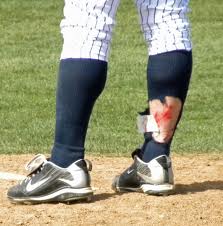
Youth Baseball: Metal or Molded Plastic Cleats What to do?

My son is starting his U13 baseball this year. U13 is the first year that the AABC league allows metal cleats. I know that metal cleats offer much better traction on both hard and soft dirt fields and on the grass outfields and infields, but is it worth the potential risks?


My son wants to get metal cleats and I suppose that I will allow him to do so. I have expressed my concerns and I have shared with him the risks. Like most decisions, I will allow him to make his own educated decisions.


Injury Risk Number One - Cleating yourself -  and perhaps one of the most annoying things that I remember from wearing metal baseball cleats when I was young - cleating yourself. I remember the pain of the metal cleat hitting my own ankle. This is more of an annoyance than anything.


Injury Risk Number Two - Getting Cleated by your opponent - One of the most common "metal cleat injuries" occurs when a base runner slides into a base and spikes the fielder. As the runner slides the cleats are exposed toward the fielder's glove, leg or foot. Of course a runner sliding head first can get his hand stepped on by a fielder with metal cleats.


Injury Risk Number Three - Too much traction - Players prefer metal cleats because they provide superior traction, however too much traction at the wrong time can result in a serious knee or ankle injury. In the game of baseball quick changes of direction happen all the time. 


(Example One) Aggressive players always look to turn a single into a double by hustling down to first and taking an aggressive turn after a hit to the outfield. If the outfielder bobbles the ball they are ready to take advantage, but if the player fields the ball clean and comes up throwing, the runner quickly reverses direction. If the runner's metal cleats dig in deep as the player is turning, a player can damage knee or ankle ligaments. This is exactly how I blow out my ACL playing men's fast-pitch softball. And I was wearing plastic molded cleats. 


(Example Two) I have also seen catchers hurt their knees blocking the plate. As the catcher gets the ball, he is suppose to position his left foot on the baseline facing third base, but many put their left foot perpendicular to the line to block more of the plate. A foot anchored in metal cleats at  an improper angle could increase the likelihood of knee and ankle injuries during a play at the plate. (See Baseball-Catcher.com for proper positioning advice)

The Main Point


Is the extra traction worth it? I am not sure that it is for 13 year old baseball players. What do you think? 

We are thinking about getting my son the New Balance baseball cleats which come in wide sizes and are suppose to be one of the most comfortable baseball cleats on the market. 

Feb 20th update:
My son ended up buying the Nike Swingman metal baseball cleats. He also bought the Ignite II Under Armour baseball turf shoes.


Wednesday, January 26, 2011

Youth Soccer: Crazy Youth Soccer Parents Video

Are you trying to decide between select travel soccer and recreational soccer? I wrote a post called "The Differences Between Select (Travel) and Recreation Soccer" that explains the differences to help you decide.

Before you read that post, answer this easy question. Is your kid nine or older?

If you answered yes, then it is probably too late to move to select soccer. What?!? You see most of the best players have had personal Brazilian trainers since pre-school. I'm half kidding.

Watch this hilarious video about a mom who is considering select soccer for her nine year old kid.

Crazy Youth Sports Parents Series


So much of this video rang true for me.

1) Regarding a Brazilian soccer trainer - My oldest son trained with a Brazilian soccer star Paulo Berreto from age 9 to 11. My son played select soccer from 9-18 on competitive teams but did not play on elite teams. He played two years of High School, but never made varsity. Perhaps we did not start him early enough?
2) My middle son was an exceptional soccer player at a young age. He decided to play football in 3rd and 4th grade. When he went back to soccer he found that he was too far behind to compete.
3) My daughter started select soccer at 8, but I trained her from the age of 2. Her soccer trainers have not been Brazilian, but they have advanced licenses. At 10 years old, she currently plays at an elite level. So maybe this video holds some truth.
4) Travel teams from Texas will rip your kid apart - We have not encountered teams from Texas in any of the soccer tournaments that my kids have played in - but strong and physical teams come from many states away to compete in the high profile tournaments.
5) Fundraising is a part of travel soccer - My kids have sold things from Honeybaked Hams to wrapping paper. Read this post of mine called "Youth Sports, I'm Done with Fundraising".
6) You need a soccer coaching license and a soccer resume to coach - My oldest son did not quite make the A team when he was 10, but the club had enough players to form two teams. A "B" team was formed, but it didn't have a coach. The Director of Coaching for the club knew that I had coached recreational soccer. He coaxed me into applying for the job. I had to earn my F license first then interview for the position. I got the job. I eventually went on to get my E and D licenses. So there is truth to this.
7) I started playing soccer at 9 years old (that was the first year it was available). I played through 9th grade. I concentrated on lacrosse after that. My dad was my first coach. He never played soccer a day in his life. So the video nailed this insight as well.
8) Back in the day, we played in T-shirts when we were really young. As we got older, we played in polyester uniforms that needed to be returned at the end of the season. Today, the kids wear expensive advanced techno-fiber home and away uniforms with matching warm-up apparel. They keep these uniforms after the season like a trophy.
9) Practices - Monday, Tuesday, Wednesday, Thursday, Friday and Saturday. No practices on Sundays. Games on Sundays. This is a bit of hyperbole. Games are on Sunday, but most younger age select teams practice 2 days per week. However, there are some very serious clubs that practice every day.

The Main Point

Sadly, there is a lot of truth in this humorous video. And my kids and I have lived it. Perhaps we perpetuate it.

Hat tip to Your Kid is Not Going Pro and Jen Singer of Momsaid.net

Tuesday, January 25, 2011

Youth Basketball: Blowout Games What to do?

Crazy Youth Sports Coach Series

I hesitate to put this under the Crazy Youth Sports Coach Series because I kind of agree with this coach. You be the judge.

Recently, the Christian Heritage Girls High School team beat the West Ridge Academy 108 to 3. The news media is up in arms about this. My question to the news media and to their viewers is what is the proper amount of points to win by? Should the team stop when the point differential get to 10 points, 20 points, 30 points? I ask the question because I really do not know.

And when the team in control gets to the politically correct point spread what should the team do? Should they play an embarrassing game of keep away? Has anyone asked why the losing team didn't slow down the pace of play? Surely, the team getting drubbed could have dribbled uncontested at the half court-line for several minutes each possession to kill time.

If you think about it, the Christian Heritage Girls HS team could have won the game 158 - 3 if they decided to employ a full court press the entire game - they did not. They could have played their starting 5 the entire game - they did not.


Game 18

My daughter's 4th grade AAU basketball team is very good. The team is 13-0 against other 4th grade teams with an average point differential of 27 points. (They are 6-4 against 5th grade teams) After the finals of a recent Martin Luther King Memorial Tournament that my daughter's team won by 33 points, a dad from the other team came up to me and said, "Wow, your team is terrific. Is there a 4th grade team in the city or even the state that can beat your team?" He was in awe of our team not embarrassed by his. That is the way all parents should feel. Praise the kids who work hard and achieve. Hold them up as an example of how to do it. Do not berate the kids, the coach or the program for being high achievers.


The Main Point


So what is the coach of a far superior team to do?

1) Stop the full court press as soon as you realize that the game will be a cakewalk.
2) Play your non-starters more than normal - however do not sit your starters the entire game. They worked hard all week and deserve to play. Especially the ones who are vying for college scholarships.
3) Slow down the pace - but do not play an embarrassing game of keep away. Run your offense - but at a more deliberate pace. Perhaps tell the kids no shooting until the team completes 5 passes.
4) Do not allow any taunting or showmanship.
5) Show the other team how the game is played.

Sunday, January 16, 2011

Youth Basketball: Teaching A Lesson

As I have frankly stated before, my son made his school's top basketball team because of heart and hustle and not for his skills. I write this openly because my son is self aware. My son understands that basketball is a sport he will most likely not play competitively beyond 8th grade. He plays for fun. Regardless, like any other experience, this may help define who he is going to be.


By the end of the 6th grade season last year, despite his lack of refined basketball skills or size, he worked his way onto the starting five of the A team. He was so proud. Hard work, heart and hustle combined with his speed and good coaching made him an outstanding defensive player. It was surely a character building year.

Easy Layup
As 7th grade basketball started, he knew that he would have to prove it all over again. His coach is demanding, many of the kids who specialize in basketball got better and many got much bigger. Nic has not had his growth spurt yet and quite frankly did not touch a basketball throughout the long baseball and golf seasons. Still he had confidence that he could out work his teammates and secure meaningful playing time.

When the 7th grade season started, Nic was a bench player again. The team has struggled in the early going and a few of the starters are prone to foul trouble so minutes are not hard to come by.

Crazy Youth Sports Coach Series

After blowout loss last week, the coach demoted four of the five starters and promoted four. My son was promoted.

On the car ride home after the ugly game, my son told me that the coach gave a tough post game speech. He told me of the demotions and the praise he got for his hustle. He was especially proud that the coach called out his all out dive on the court for a loose ball. My son was beaming.

I sat quietly and listened, but I knew that his situation was very different than last year's promotion. He had not technically earned a spot, the others simply lost their spots. I knew this was more about teaching the starters a lesson than rewarding my son.

As he continued to talk, I was having a battle in my mind. Should I tell him my thoughts or should I just let him revel. I let him revel of a day or so, but then I shared my concerns with him before the next game.

I told Nic that his hard work for a starting sport has just begun. He was a bit confused after all he was just named a starter. I told him that he will need to make every "starting" minute count if he wants to retain that spot. I told him that I think the coach is simply sending a message and the starters will likely be reinstated. If and when that happens I wanted him to know that he did not lose his spot. He told me that he thought that that was the case. I told him to take advantage of the situation.

The next game he was on the floor for the tip off. The four demoted players were on the bench with the one kid who has yet to start a game all year. After one minute and fifty two seconds, the coach sends that one non-starter into the game to replace Nic. I could see the disappointment on Nic's face. As the first quarter came to an end with the new starters holding a 3 point lead, the coach turned to his demoted starters and said, "Have you learned your lesson yet?" The kids nodded rather sheepishly. They started the 2nd quarter, played very well and stayed out of foul trouble. As a result, Nic played less minutes than he has all year.

The Main Point

I could have showered my son with compliments and told him how proud I was that he made the starting team again. But when the gig was up what would he think?

1) Understand the situation - whether you like the situation or not
2) Help you kids understand what the coach is trying to do - again whether you like it or not
3) Do not give false praise to kids - they know exactly where they fit in - honesty is always best.
4) Praise and reward hard work and hustle.

Sunday, January 9, 2011

Youth Volleyball: Why are the girl's volleyball shorts so short?

What is the deal with short tight volleyball shorts for girls volleyball?


My 4th grade daughter played in the first volleyball match of her career. My wife is the coach and she has been telling me that CC is a natural at volleyball. I had never seen CC play or even practice before today. Turns out my wife was right, CC was a star in a three game sweep. I was really not surprised that CC was good at volleyball too because she is a terrific little athlete. What did surprise me was that 4th grade parochial school girls were wearing such short and tight uniforms. The school has a very strict and conservative uniform policy during school hours.


This got me thinking. Why do women play volleyball in such short and tight shots? When did it start? I went on line to find out.


On a EastofIndy.com thread a volleyball player named Lauren says:

"There is a reason volleyball players where those shorts. It is easier to dive, roll, and move around. Every sport has there own equipment. I play volleyball."


Anwers.com does not have a good answer.


Topix covers the debate but provides no convincing answers.


Chacha.com claims flexibility and temperature control are reasons. 


Overall, the Yahoo Answers thread on the subject provided the same type answers but it still begged the question, "Why don't woman basketball players wear tight fitting uniforms. They jump, bend, twist and occasionally dive for loose balls. Vollygrl added that "your long shorts can get caught in the net, which could get called against you." Now we have a competitive advantage reason that perhaps led to the decision for the use of the shorts because this net violation costs a team a point and / or side-out. 

Still, I am just not buying these reasons.


Monday, January 3, 2011

Youth Basketball: Holiday Tournament or Family Trip?

In late November, my daughter's AAU coach wanted to add one more tournament to the schedule and asked our preference for entering one of three tournaments. One tournament was Dec 13-18, a holiday tournament Dec 28 - Jan 2 or a Feb 18-20 tournament.

We replied that we would be away during the holidays, so we would rather the team play in the early December or the mid February tournaments.

After assessing the responses from the parents the coach decided to enter the team in the Holiday Classic tournament from December 22 - January 2.

Crazy Youth Sports Parents Series

Again, we had a decision to make. My daughter had two basketball tournaments over Thanksgiving weekend that superseded our trip to visit family in Iowa. Again, my wife and I sat down and discussed the situation. We decided to rearrange our holiday schedule to accommodate the tournament and family. Instead of going to Philadelphia from December 26 - Jan 3, we decided to go December 22 to December 27.

Again we did this to set a good example. We think that it is very important to keep the commitments you make and we want our kids to learn this lesson. Sure it would have been easy to tell the coach we are not available and the coach would have been fine with it. We do not want our kids to think that it is OK to skip a class when they get to college because they do not feel like going or call in sick to work to go hang with friends. We also wanted to show that family is important too.

The Main Point

Family and keeping commitments are both very important.

We think that our decision to change our holiday plans to participate in the AAU basketball tournament communicated three things to our kids:
  1. You keep the commitments you make.
  2. You make sure that you work family into your schedule no matter how busy you are.
  3. You remain flexible.
Cross-Over Dribble Drive
Games 1 - 2 (The kids played in 189 games from March 1 when I started the blog to December 31)

CC played in the Holiday Classic Tournament. Her team went 5-0 to win the Tourney Championship. (the event that started December 28), the day we got back from visiting family in SE Pennsylvania. CC scored 7 points in the first game, 4 points in games two and three and 2 points in the finals for a total of 17 points. She also had 20 steals and 4 assists in the tourney. Her AAU team remains undefeated against 4th grade teams winning 3 tournaments.

CC's team also played a 5th league game. Three games in one day. They won easy, 19-4. CC had 2 points.

Sunday, January 2, 2011

Youth Sports: Frustrated with Blurry Action Photos? (Part 2)

Do you have a high end digital SLR but still get blurry action shots when shooting pictures inside a gym? I feel your pain. I was so frustrated when I would get a good action shot beautifully timed and framed only to get home and see that feet, hands and the ball were blurry. 

Despite buying a high end digital SLR D70 Nikon with a Nikon Nikkor 70-300 zoom lens, we struggle to get good action shots inside. The shot to the right shows my daughter walking (not running) up the court. The gym in which this shot was taken is one of the better lit gyms, yet most of the pictures are blurry.

Prior to Christmas, I received lots promotional mailers for cameras that piqued my interest because of my frustration concerning blurry basketball pictures. Basketball seems to be my daughter's favorite sport, so I thought that I would invest money in a newer camera to capture the action.

I decided to go to a photography store instead of a Big Box store like Best Buy. I wanted to make sure that I got advice from an expert before I purchased another expensive camera. 

I was considering a Nikon D7000 for $1,500. I figured that the D7000 camera would be able to capture indoor images better than my 5 year old D70. The D7000 has a 16.2 MP (million pixels) sensor compared to the 6.1 MP sensor of the D70. It also has a higher ISO range. The ISO deals with light sensitivity.

To my surprise, the expert at the store told me that my camera is not the problem, the lens I am using is. He said that he would gladly sell me the D7000 and it would produce slightly better pictures in lower light situations due to the higher dynamic range of the ISO which goes up to 6400 (the D70 max is 1600) but it would still produce blurry stop action shots in lower light situations with a standard lens. He recommended that I keep the D70 and buy a better lens with a larger aperture.

The Nikon Nikkor 70-300mm zoom lens has a f/4 and f/5.6 aperature size. (F/4 when the lens is 70mm and F/5.6 when the zoom is set to 300mm).  The larger the number, the less light entering into the lens. I needed a faster lens. 


I ended up buying the Tamron SP AF70-200mm lens with an F/2.8 (aperture) for $800. Nikon has a similar and perhaps better lens for $1200, but I was told that an amateur photographer like me would not likely notice any difference. I saved the $400 and bought the Tamron.

I am not an expert on photography but I followed the advice below on how best to capture stop action photos in low light situations and it worked for me.
  1. Buy a lens with an aperture of 2.8 or less. (Zoom lenses with this aperture are not cheap.)
  2. Set your camera to the S setting using the dial indicated with the red arrow. The S mode is an auto-exposure method in which the lens aperture is automatically set by the camera and you manually select the shutter speed.
  3. Set the shutter speed. Use the dial indicated by the blue arrow. Look at the shutter speed which can be set between 30 seconds to 1/8000 of a second on my camera. The shutter speed is indicated by the yellow arrow. Rotate the dial until you get to 250. To the right of the number you may see a warning of Lo (low light) or Hi (too much light) for the corresponding shutter speed and the aperture of the lens.
  4. Set your ISO to the maximum (1600 on the D70). Two ways to do this. A.) When the monitor is off, press the button on the back of the camera that looks like a checkers board - ISO is printed above it. (Green arrow) While holding this button rotate the dial indicated with the blue arrow. or B.) Using the monitor, press menu, highlight the camera icon on the monitor, scroll down to the ISO and select 1600.
  5. Take a test shot. If the picture is bright enough but the image is still blurry, rotate the dial marked with the blue arrow to 320 or faster. When you get the right combination for the gym you are in use it. If the image is not blurry but still a bit dark do not worry about it because you can add light after you download the image. (See step 7)
  6. Use a tripod or a mono-pod to deduce camera shake which will also cause blurriness
  7. On your computer, you can add light to any image. This is very easy to do especially on iPhoto. 
    • Click on the photo (it will be highlighted in yellow)
    • Click on edit
    • Click on adjust
    • Slide the exposure to the right until you get the right amount of light. 
    • Click on done.


My wife took the following pictures using the new lens and the advice above.

CC in mid air - no blurry feet
Fast break continues - ball suspended and clear
Low light yet great definition on moving hair

The Main Point

If you are a youth sports nut like me and your kids play inside sports like basketball, volleyball, wrestling or futsal then invest in a good zoom lens with an aperture of 2.8 or lower. You will not regret it.


Saturday, January 1, 2011

Youth Sports: Frustrated With Blurry Action Photos? (Part 1)

Are you frustrated with blurry sports action photos?

Seven years ago, I investigated digital cameras to capture sports action photos. The cost of the digital SLRs ($750 - $1,250) made me pause. A clerk at a big box store like Circuit City (now closed and bankrupt) talked me into a high end point and shoot Cannon for about $500. (These are much cheaper now.) The clerk said that the recommended point and shoot camera would be great for sports. It had the highest number of pixels available at the time, a 10X zoom and could shoot 2 frames per second.

Click here for more differences between a SLR and Point and Shoot.

I bought the camera and was instantly disappointed. The zoom capabilities were minimal and great pictures were few and far between. Expensive lesson learned.

A year later, for my 41st birthday (9/15/2005), I decided to buy the high-end digital SLR (not professional quality). I bought the Nikon D70 and a Nikon Nikkor 70-300mm zoom lens. My total investment was about $1,500.

In all honesty, I almost puked when I left the store thinking that I just spent way too much money on such a frivolous thing. Later I would discover that the investment was worth every penny. We have captured amazing photos many of which are featured throughout this blog. These pictures captured memories that would have been lost over time.

Nic at 8 yrs Old

And capturing these images is not hard to do. My very first action photo taken with my D70 Nikon camera was of my son pitching (above). I set the camera to sports mode and rapid fire picture taking. Taking 3 images per second, I was able to captured the ball suspended in the air just after the release and the strain and determination on my son's face. This one photo alone convinced me just how worthwhile the investment was. I have taken over 15,000 images since that time.

You will notice that the best pictures in this blog were taken outside in bright light. Do you have a high end digital SLR and still get blurry images of indoor sports? Read Frustrated with Blurry Action Photos? (Part 2)

The Main Point

If you are hesitating buying an expensive camera, don't. Find a way to save the money and make the purchase. If you are a sports nut, you will not regret it. You will only regret not capturing the special moments that your kids have on the field. And believe me kids grow up fast so do not delay.

Followers

LinkWithin

Related Posts with Thumbnails