Sunday, May 8, 2011

Youth Baseball: Metal or Molded Plastic Cleats What to do? (Part 2)

On January 3rd, I wrote a post questioning metal cleats for 13 year old baseball players. I enumerated the risks involved.
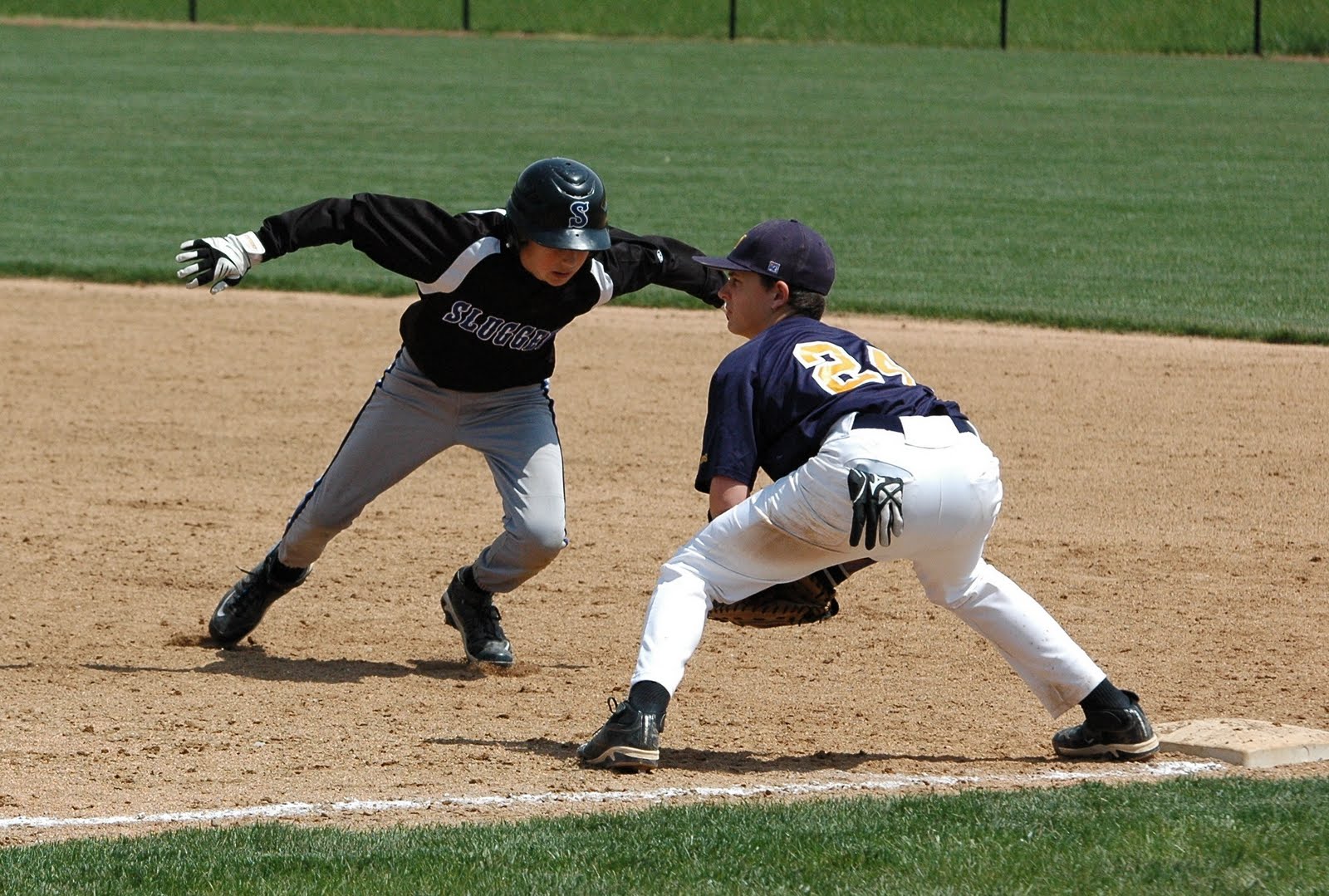
Injury Risk Number Two - Getting Cleated by your opponent - One of the most common "metal cleat injuries" occurs when a base runner slides into a base and spikes the fielder. As the runner slides the cleats are exposed toward the fielder's glove, leg or foot. Of course a runner sliding head first can get his hand stepped on by a fielder with metal cleats.
During the first game of the doubleheader on Saturday, my son Nic was diving back into first base when the first baseman stepped on his hand. The metal cleat lacerated the webbing between his pinkie and ring finger and cut the fleshy part of the side of the hand above the pinkie.


Nic was playing catcher in the game so the coach used a courtesy runner to allow Nic to go to the dugout without officially leaving the game. In the dugout, the team mom cleaned up the wounds and determined that the cuts would not need stitches. His hand was swollen and he had trouble closing his hand at first, but he had time to ice it before his next at bat. I was making plans in my mind to go to the urgent care to get the hand x-rayed,  while his coach was trying to figure out how to adjust his defensive game plan. Nic's turn to bat came up and he was determined to give it a go. Nic hit a double over the right fielders head. We all figured he was going to be ok. He also played the second game of the doubleheader and had 2 more hit.


At night, we watched Celtics Rajon Rando dislocate his elbow, go into the locker room for treatment and then return to lead the Celtic's in a win over the Lebron James, Dwayne Wade Heat. 


The Main Point

I still question whether the extra traction worth it. My son thinks that it is worth it for the cool factor alone. He loves his Nike Swingman cleats. 


And he got a big smile on his face when I compared his situation to the Rondo injury and return.


Thursday, May 5, 2011

Youth Baseball: Rare night Second Base

Note to coaches. Don't tell a young kid that he cannot do something or will never be something. Especially when the kid is only 12 years old.

My son had been the primary catcher for his previous team. He played off and on in right field too, but wanted to play infield (2nd base) on occasion. He wanted to become more versatile for high school.

I told my son to approach the coach and ask him if he could get a chance to play 2nd base in practices with a chance to earn some playing time in games. His ex-coach, chuckled at him and said, "Nic your not an infielder" and turned away. My son walked away without comment, but was absolutely furious. He was close to tears telling me the story in the car ride home from the practice. I wanted to approach the coach and plead my son's case, not for playing time but for respect and a chance. My son forbade me. I told my son to hang in there that this was our last year with this coach.

This season, my son is on a new team with a new coach. He has been playing second or catcher all year long.  Tonight he was at second base and had a terrific game, a once in a lifetime type of game.

My son made 12 of the 27 outs at second base. He fielded 8 grounders to get 8 force outs at first base. He also caught 2 pop ups and 2 line drives, one of which was spectacular and turned out to be a game saving grab.

He did not make a single error. In fact, he has only made one error at second base all year long.

The Main Point

Coaches, I am going to state the obvious. Kids change continuously. Their bodies, their confidence level, their attitude and their courage can and will all change year after year, maybe even month after month. As such, don't pigeon hole a kid into a position or prevent a kid from practicing a position he wants to learn. Who knows maybe he will be spectacular at a position.

Tuesday, May 3, 2011

Youth Baseball: A Return to the Mound After an Injury

My son, Nic, has had arm problems off and on during his baseball career. (Read Elbow Injury) Last year was a particularly frustrating year for my son. Toward the end of the season, a doctor shut him down. An MRI revealed no structural damage, but a physical test revealed that his shoulder was very weak and was causing elbow issues. After a long rest period and physical therapy with trainers, my son started going to the gym and lifting with me. He was able to play fall ball, but limited the amount of throwing he did. During winter training, he work with a baseball coach to rework his throwing motion to correct some bad habits that could be contributing to the injuries.

Nic has continued to work hard with the coach and in the gym. His arms are stronger than they have ever been and his mechanics are sound. He is throwing essentially pain free this season and returned to the mound for the first time in over a year on Sunday.

Getting the ball on the bump again

First pitch

First Pitch

First Pitch
Come backer 1-3 to end the scoreless first inning on the mound

The Main Point

Don't let arm injuries derail your son or daughter's career. Be smart. When pain persists get a doctors opinion. If the doctor recommends rest and / or therapy, follow the advice. After the doctor supervised therapy, continue strengthening the arm on your own. And don't forget the most important avoiding injury by using the proper mechanics. Get a coach to evaluate your son / daughter's throwing motion. and have them correct any mechanical issues that may be putting the young arm at risk.

Monday, May 2, 2011

Youth Basketball: The climb to an AAU National Championship (Part 5)

Looking ahead to an AAU D1 title
My daughter, CC and her team are making a run at a AAU Division I National Championship. I am following the process through this series of blog posts.


District Championships


The Ohio District for Girl's AAU Basketball held a D1 District Championship Tournament this past weekend. As discussed in the AAU Tournament Qualify Process post, the D1 District Championships have two purposes;
  1. For the teams that have ALREADY qualified for the Division I National Championship by winning a D1 Super Regional, the D1 District Championship tournament helps to establish a teams ranking in the national tourney.
  2. For teams that have NOT ALREADY qualified for the AAU D1 National Tourney, placing high or winning the D1 District Championship will both qualify a team for the Division I National Championship and rank them. (The number of teams in the District tournament determines the number of invitations given - see the qualifying process post for details)
My daughter's team had already won a Super Regional so they wanted to win the Districts to secure the best ranking possible in the AAU Division I National Championship tournament in August.

Like in the Ohio Super Regional, only 3 teams signed up for the District tournament, so only one invitation to the Division I National Tournament would be awarded afterwards. Our team already qualified for the Division I National Tournament so our objective was to do well to increase our ranking for the National Tournament. My daughter's team did do well, they won the Ohio Districts.

Ohio AAU Districts Trophy Ceremony
Since we had already qualified, the second place team qualifies for the Nationals. The second place team always gives us a challenge so they deserve to go too.

The Main Point

The climb to an AAU National Championship has been a great experience for our daughter. Her confidence and her contributions to the team have increased each and every week. She was the leading scorer in the District finals and I could not be more proud.


Sunday, May 1, 2011

Youth Sports: Gambling

This website covers the good, the bad and the ugly of youth sports. It doesn't get any uglier than the criminal element gambling on youth sports, paying pee wee players to perform or throw a game and the intimidation of those who don't.

ESPN Outside the Lines did a 7 month investigation of gambling on youth football in South Florida. Check it out.


The Main Point

Yelling at refs, conspiring against coaches, players or coaches cheating during a game, parents or coaches encouraging violence on the field, confidence killing coaches, parents drinking excessively at youth sports games, etc. are all ugly elements of youth sports that I have witnessed. Gambling, drug money and intimidation takes the ugliness to another level. I was shocked by the story at first, but I am not sure why. The ugliness I see is from middle to upper class people who typically have strong family units and quality education. The families depicted in this ESPN OTL story do not have it as easy.

Saturday, April 30, 2011

Youth Basketball: The climb to an AAU National Championship (Part 4)


My daughter, CC and her team are making a run at a AAU Division I National Championship. I am following the process through this series of blog posts.
  • (Part 1) Youth Basketball: The Climb to an AAU National Championship -Registration Process
  • (Part 2) Youth Basketball: The Climb to an AAU National Championship -Tournament Qualifying Process.
  • (Part 3) Youth Basketball: The Climb to an AAU National Championship -The Super Regional Step
  • (Part 4) Youth Basketball: The Climb to an AAU National Championship - Tips and Tricks 1


AAU Basketball Championship Tip. 


If you are on the sidelines helping the team as a coach, trainer or scorekeeper you are required to wear a collared shirt. 


The Main Point
I did not have on a collared shirt for the first Super Regional game and couldn't keep score for the team. 

Wednesday, April 27, 2011

Youth Sports Fanatics by Nature or Nurture? (Part 2)

In November, I was interviewed by Mark Hyman, professional journalist and blogger (Youth Sports Blog) about youth sports. He asked about our obsession with youth sports. 


I told him that we're a sports family. My wife and I both come from sports families. Read Youth Sports Fanatics by Nature or Nurture? for the long history. We love sports and either by nature or nurture our kids love sports too. None of us can get enough of sports.


Here is more proof that nature might have something to do with it. I was talking to my wife's grandfather Leroy, who is 97, he told us that his father was an athlete. In fact, his father, my son's great great grand father, played professional baseball in the Mississippi Valley league in the early 1900's. Leroy told us that could have advanced further in the sport, but his parents forbade him from playing on Sundays. 


Fred Sherman Whannel - Catcher - 1910 (Left)


The Main Point


What makes this nature or nurture debate even more interesting is that my son is a catcher and his grand father (My dad) was a college catcher and based on the picture above, my son's great great grandfather was a catcher too. (Check out the glove of the player on the left above - compare the glove in the picture to these historical gloves.)


Nic - Catcher - 2010

Friday, April 22, 2011

Youth Sports: Live to Play

To succeed at youth sports your kid needs skills, dedication, fearlessness, an opportunity and some good coaching. Oh yeah I almost forgot the most important part. your kid needs to exist. I am always fascinated by all the things that needed to happen throughout history for my kids to be born.

My wife's grandfather, Leroy is 97 and I love to visit him because he is a terrific story teller. Every time we talk to him we seem to hear stories about lust for adventure and a couple near death experiences.

Today he told us about the house he grew up in on the Detroit river, the river that connects Lake Erie with Lake St. Clair. Leroy used to ice skate on the river when it froze over. One day skating alone he fell through the ice. As he was falling he put his arms out to form a T. This kept him from falling completely through. The river underneath the ice was flowing at about 4 mph so if he let go he would float way from the hole and be completely trapped under the ice. He tried to kick himself up, but the heavy skates made this seemingly impossible. He tried one last time and felt a pull from his collar as he slipped up onto the ice. He looked around to see who pulled him up. There was no one there. He told us that his belief in God was strengthened that day.

On another day, Leroy decided to skate out under a distant bridge. The ice was firm and fast on the side canals, but under the bridge the current was stronger and the ice was thinner. When he reach the bridge he fell right through the ice. He tried to pull himself back up, but could not. Each time he tried to pull him self up, the ice would break further. His only chance was to keep breaking the ice and expand the hole by punching it. With each punch the ice gave way and allowed him to get closer and closer to a bridge support. Finally, he was able to reach the bridge support and pull himself up.

Finally, on a very windy summer day, Leroy took his sail boat out onto the river. He was a master sailer and he skillfully navigated the currents and winds on that day until he notice that a rope slipped out of place on his boat. To fix the problem he had to let go of the rudder. An instant after letting go, the wind and current turned the boat and the boom from the mast swung around and knocked Leroy out of the boat unconscious. He landed on his back and floated face up. He's not sure how long he was floating before he eventually regained consciousness. He does remember that it took him a few seconds to even realize that he was in water. As soon as he did, panic replaced the relaxed unconscious state he was in and he immediately started to sink. He looked up and saw his boat 20 yards away floating down river at the same speed as he was moving. He was able to swim over and get back on the boat. I said, "wow lucky you had a life preserver on." He said, "I did not have a life preserver on, those are for sissies."

The Main Point
97 year old Leroy Whannel with his great grand kids
I watched my kids as they listened in wonder to Leroy's stories. I wondered if they understood that if Leroy did not survive these accidents that they would not be there to listen in wonder. Did I mention that Leroy was on Normandy Beach during the D-Day invasion? That is a story for another day.

Wednesday, April 20, 2011

Youth Sports: Gatorade Become Campaign

Gatorade is running a campaign called BECOME to promote their G Series products. It's an authentic campaign that is rooted in real consumer insights. I believe that these ads will resonate with Gatorade buying moms because they beautifully illustrate the real emotional bond between moms and their little athletes. 


I like the ads, but I have to admit, I am disappointed that Dads are not featured too. The insights that make these ads so strong are true to both moms and dads. And Dads buy lots of Gatorade. 


The Main Point


Moms are planners, they buy Gatorade in bulk at the grocery, club or mass store. Dads are forgetters, they forget to get the Gatorade out of the refrigerator before the game and then need to stop at the local convenience store or concession stand to buy more. Both moms and dads are important to Gatorade. Therefore, I think that they should feature dads in their ads.


BTW - I am not paid to talk about Gatorade.


Monday, April 18, 2011

Youth Basketball: Passing Down Traditions

When I was about eight years old, my dad bought a basketball hoop. The local handy man attached the white fiberglass backboard with its orange rim right on the front of our house. It was an eyesore for all passersby to see. I'm sure my mom hated it, but my dad, an accomplished college basketball player, considered a basketball hoop a necessity.

My dad and I used to play for hours. My dad taught me the basics of basketball and taught me how to play Around-the-World, H-O-R-S-E and 5-3-1. Over time my dad taught me modified versions of the games to make them more interesting. Eventually I would teach my kids these games and we would modify them further.

5-3-1 was my favorite game.

5-3-1 Basic Rules

5-3-1 is a game that can be played with 2 or more players. Although there were plenty of times I played the game by myself pitting my right hand versus my left hand.

Each player takes a turn shooting a set of three uncontested shots; a 5 point shot from 20 or more feet out, a 3 point shot from the foul line and a one point lay up. If the player makes all three, he or she records 9 points and goes again.

If the player misses any of the three shots, the player counts up his or her points and passes the ball to the next player. The players take turns shooting their set of shots until someone scores 21 points.

The winner has to score 21 points exactly. At the end of the game, a player may need to miss a shot on purpose to avoid going over 21. To make it interesting, each shot had to hit the backboard or rim to count. If the player missed entirely or made the shot, they would go back to zero. Harsh I know (See advanced rules #3)

5-3-1 Advanced Rules 

Here are some advanced rules - you can add any one, any combination or all four of these.

1) If a player misses all three uncontested shots - the player goes back to zero.

2) Add in rebounding. Instead of shooting the 3 point shot from the free throw line and the 1 point shot as a layup, the 3 pointer is shot from the place on the court where the shooter rebounds his 5 point shot and the 1 pointer is shot from the place the shooter rebounds the 3 point shot.  If the player makes the 5 point shot, the 3 pointer is taken from the foul line. If the 3 point shot is made, the player shots the 1 pointer as a layup.

3) Modify the penalty for going over 21. In the basic rules the penalty for going over 21 or shooting an air ball is harsh. The player who commits these errors reverts back to zero points. We modified the rule so that the games do not take forever. The modified penalty is to subtract the amount of points of the shot taken. For example if a player has 17 points a 5 point shot would put the player over 21. If the player made the 5 pointer by mistake or missed the rim / backboard completely they would lose 5 points and go back to 12. The same rule applies to 3 point shots and 1 point shots.

4) My son and I added a new twist to the game just the other day. We played 5-3-1 with the basic rules as described above, but instead of an uncontested layup for 1 point we allowed the other player to defend the basket. We also allowed the opponent to defend any 5 point or 3 point potential winning shots. So if the score a player had 17 points, the opponent could defend the 5 point shot, but could not defend the 3 point shot. The 1V1 element added new excitement to the game. He beat me 2 of 3 games.

The Main Point

My dad now 73
Several years ago, my dad gave me a generous gift of money. It was enough money to put up a basketball hoop in our side yard. It was the perfect use of his money.

There is a circle of life for sports. My dad passed on his knowledge of the game to me and I am teaching my kids. One day, my kids will be teaching my grandchildren. Luckily my dad passed on his basketball genes through me to my kids. I was not a great player. Hopefully they will get his height (6 ft. 5 in) too.
Great Basketball Players Skip A Generation

Thursday, April 14, 2011

Youth Baseball: Keeping Score

Keeping the book for a baseball game is so easy a 10 year old girl can do it. Literally.

My daughter loves to keep the book for her brother's games
The Main Point

There are very few parents who know how to keep the baseball scorebook. And most of the people who think they know how to do it are not very good at it. I'm not sure why because it is not very difficult to do. Keeping score is a skill that is typically passed down from father to son or daughter. My dad taught me how to keep score at Veterans Stadium (Philadelphia Phillies)

I know this is unusual, but my daughter loves to watch her older brother play baseball. Several years ago when my daughter was 8, she watched every inning of the CABA World Series. During that series, I taught her how to keep score. Last weekend, she asked if she could keep score again. I handed her the book. I was surprised at how much she remembered. After a few innings of guidance, she was flying solo.

Sunday, April 10, 2011

Youth Baseball: Find a Confidence Building Coach

To succeed in baseball you need skills, knowledge, passion, a short memory and the most important ingredient, confidence.

My son had all of these ingredients until last year. Last year, my son struggled and I blame myself because I saw it coming.

My son enjoyed three years of success playing under a task master head coach who taught him the game and an assistant coach who built his confidence. After the 2009 season, the confidence building assistant coach left the team. Unfortunately, he left with little notice so we didn't explore options. 

Prior to the 2010 season, my wife and I were very concerned about my son's baseball psyche without the assistant coach there to counterbalance the head coach. Sure enough, Nic had the worst season of his career and 2010 turned out to be a long painful season to endure as predicted. There were some bright spots during the year, like Nic's first home run over a fence in Noblesville Indiana and the entire Cooperstown Dreams Park Tournament. Despite these highlights my son still contemplated quitting the game that he loved so much once. 

Luckily, I persuaded my son to tryout for other teams for the 2011 season. During the tryout process,  coaches saw his potential, his leadership and his knowledge of the game. All of them were complimentary. The tryout process was the first step back to a confident state of mind. 

During the tryout process, we interviewed coaches with as much scrutiny as the coaches were evaluating my son. We were in search of a confidence building coach. We not only found a confidence building coach, but we found an entire coaching staff who would provide a positive environment. We jumped at the opportunity.

My son played fall ball with the new team and struggled in the beginning. His self-confidence was still low, but the confidence that the coaching staff had in my son was still sky high. By the end of the fall ball season, my son was hitting the ball hard and was looking forward to the spring season.

Single over the SS
Returning to the Field after a 3 Run Double
This weekend, playing against some of his old teammates who were now scattered among other teams, he enjoyed success again. In the semi-final game of the tournament he had 6 RBIs. He did it by getting back to his old style of hitting the ball the other way. 

My son also played a flawless second base (when he wasn't catching). When my son asked his previous coach if he could earn a chance to play second, the coach chuckled and told my son that he is not an infielder. He completely dismissed him.

It was a thrill for me to watch my son this weekend. I got to see his contagious smile and his geniune love of the game again. 

The Main Point

Quick word of advice. Find a coach who builds confidence and run away from a coach who erodes it. I was an idiot for not finding a better situation for my son last year.

Saturday, April 9, 2011

Youth Sports: The Parent / Coach Dynamic

Some select youth sport clubs have rules that prohibit parents from being the coach of their kid's team. I guess they have this rule in place because the parent / coach dynamic is very tricky. I have seen some coaches who are great at the balancing act and others who were epic failures. I have played a starring role on both sides.

I have three kids who have played on countless teams for countless coaches so I have seen it all. Currently, my daughter's elite soccer team and AAU basketball team have paid non-parent coaches. My son's select baseball team has a paid trainer, but the head coach and all the assistant coaches are parents of players on the team.

Here are the most common coach / parent scenarios.

  1. The parent / coach thinks his son or daughter is better than he or she really is and favors them. They play their kid at all the choice positions and give them lots of playing time while the rest of the players and their parents boil with resentment.
  2. The parent / coach favors their son or daughter who happens to be the best on the team. The parent / coach plays their kid at all the choice positions and gives them a disproportionate amount of playing time. The rest of the team reluctantly accepts this because the kid has earned the playing time and positions and they want to be a part of a winner. The parents do get upset when the star player / coaches kid is still playing in a game that the outcome is all ready determined. (i.e. If a football team is up 28 - 0 and the coach is calling plays for the star quarterback so he can get his 5 TD of the game.)
  3. The parent / coach has unrealistic expectations of his own son or daughter and treats them poorly. I couldn't wait for my older son to play baseball, the game I loved. My oldest was a good athlete and had a great arm. He, however, was not good at baseball. It turned out that he had / has ADHD and the slow game of baseball just couldn't capture his attention. Not knowing anything about ADHD or that he even had it at the time, I was infuriated by his lack of focus, hustle and ability to learn the fundamentals of the game. I was overly harsh toward him. The other kids and parents loved me as a coach, but I was a terrible coach for my son. I was young, stupid and overly concerned about winning and stats. Luckily, I have matured as a coach. Since this low point in my coaching career, I have seen many coaches treat their own kids poorly and it makes me cringe because it reminds me about my own stupidity as a young coach.
  4. The parent / coach wants to look unbiased so they treat their very deserving kids unfairly. (i.e. They bat a their son low in the batting order when he deserves to bat at the top)

Coach Lokar from the Positive Coaching Alliance developed 25 tips for the Parent / Coach. These were  featured in a three part series on ChicagoNow.com

The New Apprenticeships - Playing for Coach-Dads & Coach-Moms 

  1. Part One
  2. Part Two (Tips 1 to 10)
  3. Part Three (Tips 11 to 25)
The Main Point

Parent Coach U7 Soccer
It is much tougher to coach a team when one of the players is your own kid. It can be a no-win situation. 

As I mentioned above, I wasn't a very good parent / coach with my first child, but I learned from the experience. By the time I was coaching my third child I had figured out most of the tips outlined by Coach Lokar. I highly recommend that you read the 25 tips and take them to heart if you are going to be the coach your kid's team.


Thursday, April 7, 2011

Youth Sports: Are you on the same page with your Kid's coach? (Part 2)

In very competitive select youth sports, many kids have a coach / coaching staff and they have a private trainer. What do you do when the two fundamentally disagree? There are two ways to handle this: The right way and the wrong way. I wrote about the wrong way yesterday.


This is the right way.


The Right Way

My son did not get off to a great start this year and he thought to himself, here we go again. The poor start was not surprising because he faced some of the best pitchers in the region in an elite pre-season tournament. It was not surprising because he was hitting in 28 degree temperatures. And it was not surprising because he was swinging violently and trying to pull everything to right field again. As a result, he was pulling off the ball and not making good contact.

After the tough tournament, I talked to my son about his approach. I told him to stop swinging so violently and just try to put the big part of the bat on the ball and drive the ball the opposite way.

During batting practice, the hitting coach for his new team (an ex-Mets AAA player) told Nic to go after it. Asked him why he was holding back. Nic had a right to be frustrated.

After the practice, I pulled the head coach and the batting coach aside. I wanted to get on the same page with them. We came up with a plan and a message track that we all agreed was the best approach. In short, we agreed that Nic should work on seeing fast balls longer and hitting them up the middle or to the opposite field. The next day, I took Nic to the batting cage and we worked on just that.

Single over SS
The first 12 ball hitting session was a pull-fest and my son didn't hit many of the balls hard. He came out of the cage frustrated. I said, "Nic you haven't changed a thing. Wait, Wait, Wait then drive the ball up the middle or to left field." He went back in and worked on waiting.  After a few rounds, it started to click. He left the batting cage facility with confidence that his old swing was coming back.

Afterwards, I email the head coach and the hitting coach with an update on the great batting session. The head coach email back a supportive message. The hitting coach left a VM on my son's phone reiterating the message track, some confidence building comments about quickness in his swing that will serve him well now, high school and perhaps beyond. Great words to hear from a guy who has had success in baseball.

Last night, Nic went 3 for 4. He hit 3 balls to the opposite field and pulled an offspeed pitch into the gap in right center field.

The Main Point

A consistent message is the key. If a kid is getting conflicting instructions from three different sources (coach, dad and trainer) than confusion will set in. Not only that, but no matter what the kid does, two of the three sources will not be happy. 

Wednesday, April 6, 2011

Youth Baseball: Are you on the same page with your kid's coach

In very competitive select youth sports, many kids have a coach / coaching staff and they have a private trainer. What do you do when the two fundamentally disagree? There are two ways to handle this: The right way and the wrong way.

The Wrong Way

Last year, my son experienced the first slump of his life. Over 3 seasons of select baseball, he earned a lifetime .468 batting average by hitting the ball the opposite way to left field (he bats lefty). He got on base with regularity and he caused havoc on the base paths stealing 150 or so bases in 160 or so tries. This style of play earned him a spot on the All Tournament Team at the CABA World Series. Why mess with success right?

My son is not big, but has tremendous bat speed and a lot of pop in his bat. The coach of the team recognized this and wanted my son to change his approach and pull the ball more often. He was hoping that my son would hit for more power.

Admittedly, I was not opposed to this as I believe that to be a great hitter you need to hit to all fields. This approach was counter to my son's private hitting instructor who preached looking at a pitch as long as possible and hit it the other way. He believed that as my son faced faster pitchers who also had offspeed pitches, Nic would be able to drive the fastballs to the opposite field and not be fooled by the off speed pitches.

Well, my son liked the idea of hitting more home runs so followed the plan of the team's coach. He worked on pulling the ball all winter long. When last season started, he got off to a terrible start. He was pulling off the ball and making contact with less frequency. Yes, when he made contact, the ball went farther, but his average dropped significantly. As his average dropped, so did my son's confidence and this deepened the slump. The coach tinkered some more until my son was so screwed up he could not even foul the ball off.

Age 7 Hitting to the Opposite Field
We went back to Nic's private hitting coach, Coach K. Coach K is the same coach that made my son into an opposite field hitting machine from the age of 7. I spent $60 per hour over several sessions to rebuild his swing and his confidence.

What I didn't do was tell the coach what the game plan was. He was simply not the type of coach who wanted to hear a parent's point of view. I simply told my son to follow Coach K's advice. He struggled at first, but he started to come around.
Age 12  Hit...

or Miss.
The team had an indoor batting session one mid-season rainy day. The team coach was working with Nic and undoing everything that his private hitting coach had worked on just the day before. He wanted my son to try a big leg kick as he loaded.

I yelled, somewhat rudely, for the coach and told him that we're not going to do that. I was actually surprised that I spoke up. I had to look around to see if I was the one who actually yell it. But it must have been me, because the coach glared directly at me. I collected my thoughts and I told him what we were doing and what the plan was. The could tell that the coach took umbrage with my interference.

We did not get on the same page and sadly our relationship suffered. He was a great coach for three years, but the final year with the coach was a struggle for my son and for me because I was working against him instead of with him.

The Main Point

If you are going to be involved with the development of your young athlete, get on the same page as your coach. Work with your coach not against him or her.

Followers

LinkWithin

Related Posts with Thumbnails